World Rainforests: Deforestation in Brazil
Deforestation in the Amazon

What can de done to save the Amazon rainforest in Brazil?
Until recently, Brazil has faced an enormous challenge: how to balance economic growth with the preservation of the Amazon rainforest. But the past decade has shown it can rise to the occasion, reducing deforestation while continuing to expand agricultural output. But whether that trend continues is an open question. Furthermore will Brazil's success in limiting deforestation simply displace clearing to neighboring countries?
UPDATES:
- How to save the Amazon rainforest 2009
- Brazil's plan to save the Amazon rainforest 2009
- In cutting deforestation, Brazil leads world in reducing emissions 2014
Some steps for reducing deforestation in Brazil.
- Rehabilitation and increased productivity of formerly forested lands
- Expansion of protection areas
- Development based on concepts of sustainable use of some existing forest
- Land policy reform
- Law Enforcement
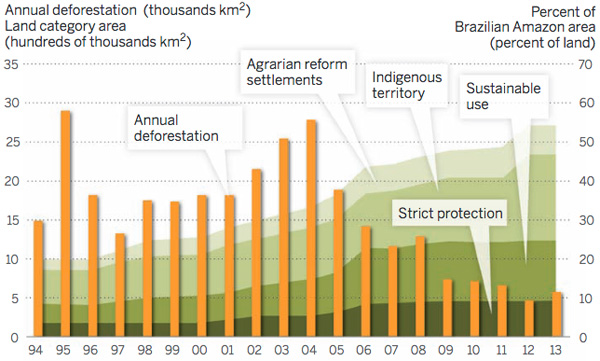
Annual deforestation and the area of indigenous territories, sustainable development reserves (e.g., extractive reserves), strict protection reserves, and agrarian reform settlements. Image courtesy of Nepstad et al 2014
Rehabilitation and increased productivity of formerly forested lands
There are tens of millions of low productivity cattle pasture in the Brazilian Amazon. These areas were long ago cleared of forest and today have very little value for agricultural production. Improving productivity in these areas has vast potential to increase agricultural output without the need to clear new forest.
INCREASING PRODUCTIVITY:
- Increasing productivity of cleared rainforest lands is possible using improved technology to generate higher yielding crops. Taking advantage of improved germplasm developed through careful selection can produce grasses and crops that will grow on degraded forest soils. While technology may have accelerated the development and impoverishment of tropical rainforests, it will be one of the keys to saving them.
When it comes to cattle pasture, Judson Valentim of the Brazilian Farm Research Corporation (Embrapa), suggests that "the use of so-called alternative technologies, such as non-plowing farming, could increase productivity in areas that have already been cleared ... Proper use of the area of the rainforest already cleared (deforested or destroyed) in the Amazon could solve many problems. He points out that 20 percent of the area could produce 50 million tons of grains annually. Another 20 percent could be used for small farmers (around 900,000 of them if each got 20,000 hectares)."
Valentim continues, "The remaining 60 percent would be used to raise 100 million head of cattle. And all that, without cutting down a single, additional tree or burning so much as one hectare." [Marrying Growth and Preservation in Brazil's Amazon]
One promising area of research looks at ancient societies that lived in the Amazon rainforest before the arrival of Europeans in the 15th century. Apparently these populations were able to enrich the rainforest soil, which is usually quite poor, using charcoal and animal bones. By improving soil quality, large areas of the Amazon that have been deforested could be used to support agriculture. This could help reduce pressure on rainforest areas for agricultural land. Further, the "terra preta" soil could be used to help fight global warming since it absorbs carbon dioxide, an important greenhouse gas.
-
The restoration of entire ecosystems is most possible in regions where parts or at least remnants of the original forest still remain and there are few human population pressures. Small clearings surrounded by forest recover quickly and large sections may recover in time especially if we provide some assistance in the reforestation process. After several years, a once barren field can once again support vegetation in the form of pioneer species and secondary growth. Although the secondary forest will be low in diversity and poorly developed, the forest cover will be adequate for some species to return (assuming they still exist). In addition, the newly forested patch can be used for the sustainable harvest of forest products and low intensity logging.
Tracts of replanted forest may have ecological returns in addition to economic ones. In the short term, forests absorb large amounts of atmospheric carbon and the more trees that are replanted, the more atmospheric carbon will be sequestered. Replanting and rehabilitating secondary forests around the world has tremendous potential for offsetting greenhouse gas emissions. Furthermore, rehabilitated forest lands can attract ecotourists and offer habitat for native forest wildlife.
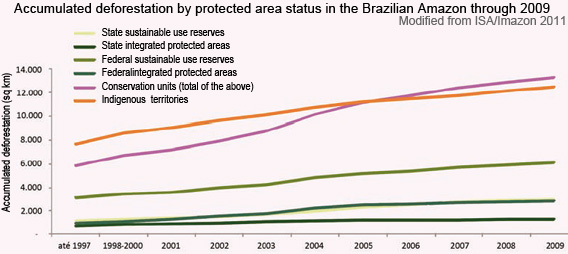
Accumulated deforestation by protected area status in the Brazilian Amazon through 2009
Expansion of protection areas
Brazil set aside more land in protected areas than any other country during the 2000s, accounting for nearly 60 percent of total terrestrial conservation during the decade. Protected areas now cover nearly 44 percent of the Amazon — an area larger than Greenland.
Nearly half this area consists of indigenous territories, which research has shown have even lower deforestation rates that national parks.
Under Brazilian law, it's not just parks and indigenous territories that are protected. Landowners in the Amazon are required to keep at least 80 percent of their land forested, including areas along rivers and near wetlands. However these legal forest reserves tend to be more degraded than officially protected areas due to timber harvesting and the impact of fire and livestock.
In 2014, the Amazon Region Protected Areas (ARPA) program secured $215 million in funding to keep it running for another 25 years. ARPA areas comprise 15 percent of the Brazilian Amazon.

Map by: WWF. Click to enlarge.
Sustainable Development
Encouraging companies and other actors in the Amazon to adopt less damaging practices is a key part in maintaining the integrity and ecological function of Earth's largest rainforest.
Agriculture [more]
For thousands of years parts of the Amazon has been managed to sustain productive agriculture and at times, sustain dense human populations. It is estimated that more land was under cultivation in the Amazon on the eve of the arrival of Columbus than is today. The fact that certain forms of agriculture are possible is a vital consideration for the sustainable, economic development of tropical rainforests.
Actions to take:
- Incorporate the techniques of indigenous Amazonians into agricultural projects in the rainforest to increase the productivity of degraded forest lands and promote sustainable use of forest resources. Through agroforestry, polycultural fields, and floodplain orchards outright destruction of rainforests can be avoided, while improving economic efficiency and providing a source of income for rural poor
- End subsidies granted for conversion of large blocks of rainforest
Logged ares have much higher rates of deforestation than unlogged areas in the Amazon. Logging roads open previously inaccessible area to ranchers, farmers, and colonists. Logging can also reduce the value of a forest area, increasing pressure to convert it for agriculture or timber plantations.
Actions to take [more]:
- Enforce existing laws. A 2014 investigation by Greenpeace found widespread fraud in the state of Paráa's timber management system, allowing illegally logged timber to be laundered as sustainably harvested. Corruption and incompetence play a key role in enabling such activities.
- Cut subsidies for saw mills and road construction to more accurately reflect the true costs of harvesting.
- Restrict the trade of certain rainforest tree species.
- Establish plantations on degraded lands. Forest plantations are essentially tree crops planted for the particular purpose of providing a specific source for wood products.
- Use reduced impact logging. Reduced impact logging practices including: 1) cutting climbers and lianas well prior to felling; 2) directional tree felling to inflict the smallest impact on the surrounding forest; 3) establishing stream buffer zones and watershed protection areas; 4) using improved technologies to reduce damage to the soil cause by log extraction; 5) careful planning to prevent excess roads which give access to transient settlers; 6) reducing wood waste for cut areas (anywhere from 25-50% of the wood from a given cleared patch is wasted); 7) limiting the gradient of roads to prevent excess erosion.
Clearing for pastureland and land speculation purposes is a major cause of tropical forest loss, especially in Latin America. Cattle are an attractive investment for Amazonian farmers because they are a highly liquid capital asset with low marginal costs once forest has been cleared. Cattle are used to establish land claims on otherwise "unoccupied" rainforest land and can be used as a hedge against inflation.
Actions to take:
- Eliminate tax incentives and land policies which encourage conversion of forest to pasture.
- Improve pasture management
- Enforce rural land registries which tie landowners to specific properties
- Encourage customers to demand deforestation-free beef and leather

Phases in the evolution of public policies and supply chain initiatives to control Amazon deforestation: 2000 to 2013. Image courtesy of Nepstad et al 2014
Land policy reform
The land reform movement gathered pace in the 1990s and 2000s. Nonetheless there are still opportunities for reform, including improving the Instituto Nacional de Colonização e Reforma Agrária, Brazil's National Institute for Colonization and Agrarian Reform, which continues to dispense rainforest lands for conversion. Studies have shown that areas controlled by INCRA have extremely high rates of deforestation.
Law Enforcement
Brazil has made considerable advances since the mid-2000's when lawlessness reigned across much of the Amazon. The government is now implementing a rural land registry that will tie properties to specific people and companies. That will help create more accountability across the vast rainforest region.
Brazil has also increased resources allocated for environmental law enforcement, greatly expanding IBAMA, Brazil's Environmental Protection Agency, which in 2003 had only $9.5 million to police the entire Amazon. The agency however still battles internal corruption and has difficulty collecting the fines it issues.
Conclusion
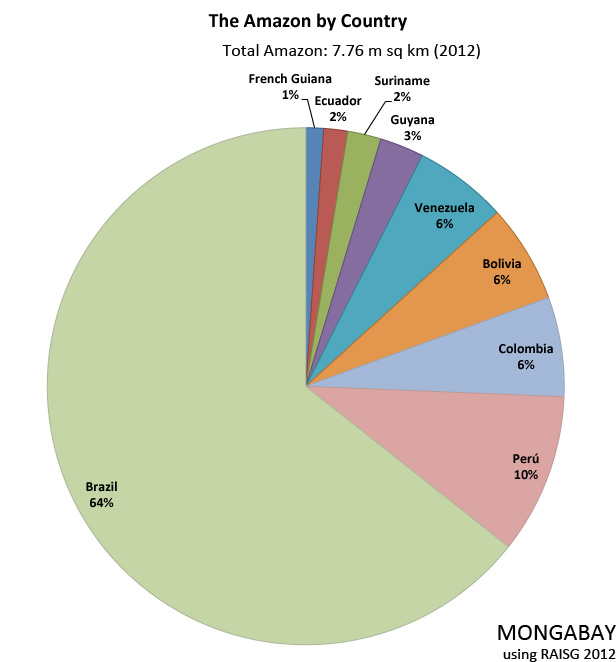
Brazil contains nearly two-thirds of the Amazon rainforest, making it a critical priority in terms of protecting biodiversity, slowing climate change, and maintaining important ecosystem functions. While deforestation has slowed dramatically over the past decade, the fate of the world's largest rainforest still hangs in balance due to ongoing forest loss, planned industrial projected like hydroelectric projects that could block five of the Amazon River's six major tributaries, and the uncertain impacts of rising temperatures and drier conditions.
More on deforestation in Brazil
Why is the Brazilian Amazon being Destroyed?
Today deforestation in the Amazon is the result of several activities, the foremost of which include:- Clearing for cattle pasture
- Colonization and subsequent subsistence agriculture
- Infrastructure improvements
- Commercial agriculture
- Logging