TROPICAL RAINFORESTS: Deforestation in Brazil
 Home
 What's New
 About
 Contribute
 Submissions
 Rainforests
   Mission
   Introduction
   Characteristics
   Biodiversity
   The Canopy
   Forest Floor
   Forest Waters
   Indigenous People
   Deforestation
   Consequences
   Saving Rainforests
   Amazon rainforest
   Borneo rainforest
   Congo rainforest
   Country Profiles
   Statistics
   Works Cited
   For Kids
   For Teachers
   Photos/Images
   Expert Interviews
   Rainforest News
   XML Feeds
   Chinese
   French
   Japanese
   Spanish
   Other Languages
 Pictures
 Books
 Links
 Newsletter
 Education
 Mongabay Sites
   Kids' site
   Travel Tips
   Tropical Fish
   Madagascar
 Contact


About this site
Providing tropical forest news, statistics, photos, and information, rainforests.mongabay.com is the world's most popular rainforest site. [more]


Deforestation in the Amazon


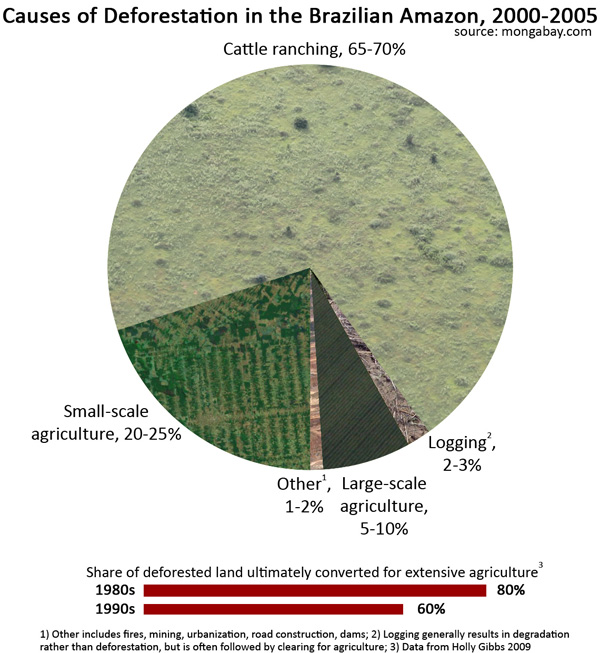
DEFORESTATION IN BRAZIL: 60-70 percent of deforestation in the Amazon results from cattle ranches while the rest mostly results from small-scale subsistence agriculture. Despite the widespread press attention, large-scale farming (i.e. soybeans) currently contributes relatively little to total deforestation in the Amazon. Most soybean cultivation takes place outside the rainforest in the neighboring cerrado grassland ecosystem and in areas that have already been cleared. Logging results in forest degradation but rarely direct deforestation. However, studies have showed a close correlation between logging and future clearing for settlement and farming. [Português | Español | Français]

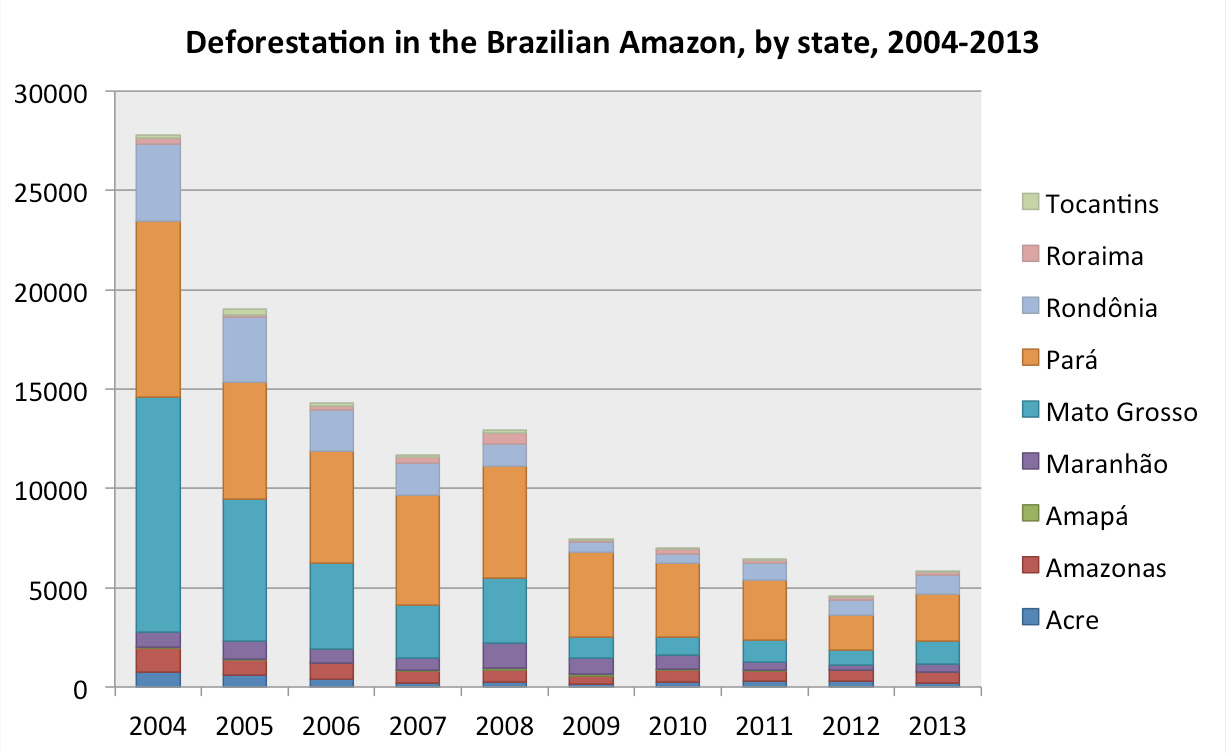
Deforestation by state


Deforestation Figures for Brazil


Year
Deforestation
[sq mi]
Deforestation
[sq km]
Change
[%]
19888,12721,050
19896,86117,770-16%
19905,30113,730-23%
19914,25911,030-20%
19925,32313,78625%
19935,75114,8968%
19945,75114,8960%
199511,22029,05995%
19967,01218,161-38%
19975,10713,227-27%
19986,71217,38331%
19996,66417,259-1%
20007,03718,2266%
20017,01418,1650%
20028,26021,65117%
20039,80525,39619%
200410,72227,7729%
20057,34119,014-31%
20065,51514,285-49%
20074,49811,651-18%
20084,98412,91111%
20092,8827,464-42%
20102,7027,000-6%
20112,3736,418-8%
20121,7984,656-27%

All figures derived from official National
Institute of Space Research (INPE) data
. Individual state figures.

* - For the 1978-1988 period the figures represent
the average annual rates of deforestation.

NOTE: 2012 data is preliminrary


Causes of deforestation in the Amazon
Cattle ranches 65-70%
Small-scale, subsistence agriculture 20-25%
Large-scale, commercial agriculture 5-10%
Logging, legal and illegal 2-3%
Fires, mining, urbanization, road construction, dams 1-2%
Selective logging and fires that burn under the forest canopy commonly result in forest degradation, not deforestation. Therefore these factor less in overall deforestation figures.


The above pie chart showing deforestation in the Amazon by cause is based on the median figures for estimate ranges. Please note the low estimate for large-scale agriculture. Between 2000-2005 soybean cultivation resulted in a small overall percentage of direct deforestation. Nevertheless the role of soy is quite significant in the Amazon. As explained by Dr. Philip Fearnside, "Soybean farms cause some forest clearing directly. But they have a much greater impact on deforestation by consuming cleared land, savanna, and transitional forests, thereby pushing ranchers and slash-and-burn farmers ever deeper into the forest frontier. Soybean farming also provides a key economic and political impetus for new highways and infrastructure projects, which accelerate deforestation by other actors."


Colombia

Overhead view of the Río Huaypetue gold mine in Peru


Rainforest cleared for maize


Geometric patterns of deforestation


Slash-and-burn agriculture in the Amazon rain forest of Peru
Slash-and-burn agriculture in Peru


Plane view of deforestation in the Amazon


Mining operations at Rio Huaypetue gold mine
Mining in Peru


Mining trucks, equipment, opne pits and roads at the Rio Huaypetue gold mine in southeastern Peru
Mining in Peru


Amazon rainforest and cattle pasture


Clear-cutting in the Amazon rainforest as viewed from above by airplane
Clear-cutting in the Amazon rainforest


Overhead view of clear-cutting for slash-and-burn agriculture in the Peruvian Amazon
Slash-and-burn agriculture in the Peruvian Amazon


Giant Rio Huaypetue gold mine


Aerial view of deforestation in the Amazon


Lone Brazil nut tree left standing in a deforested area


Clearing of Amazon forest for pasture or soy


Mining trucks and equipment at the Rio Huaypetue gold mine in Peru
Mining in Peru


Aerial view of open pit mine in the Amazon rainforest
Mining in Peru


More deforestation pictures, including Brazil, Colombia, Peru, and Suriname.


By Rhett A Butler
[last update: 20 May 2012]

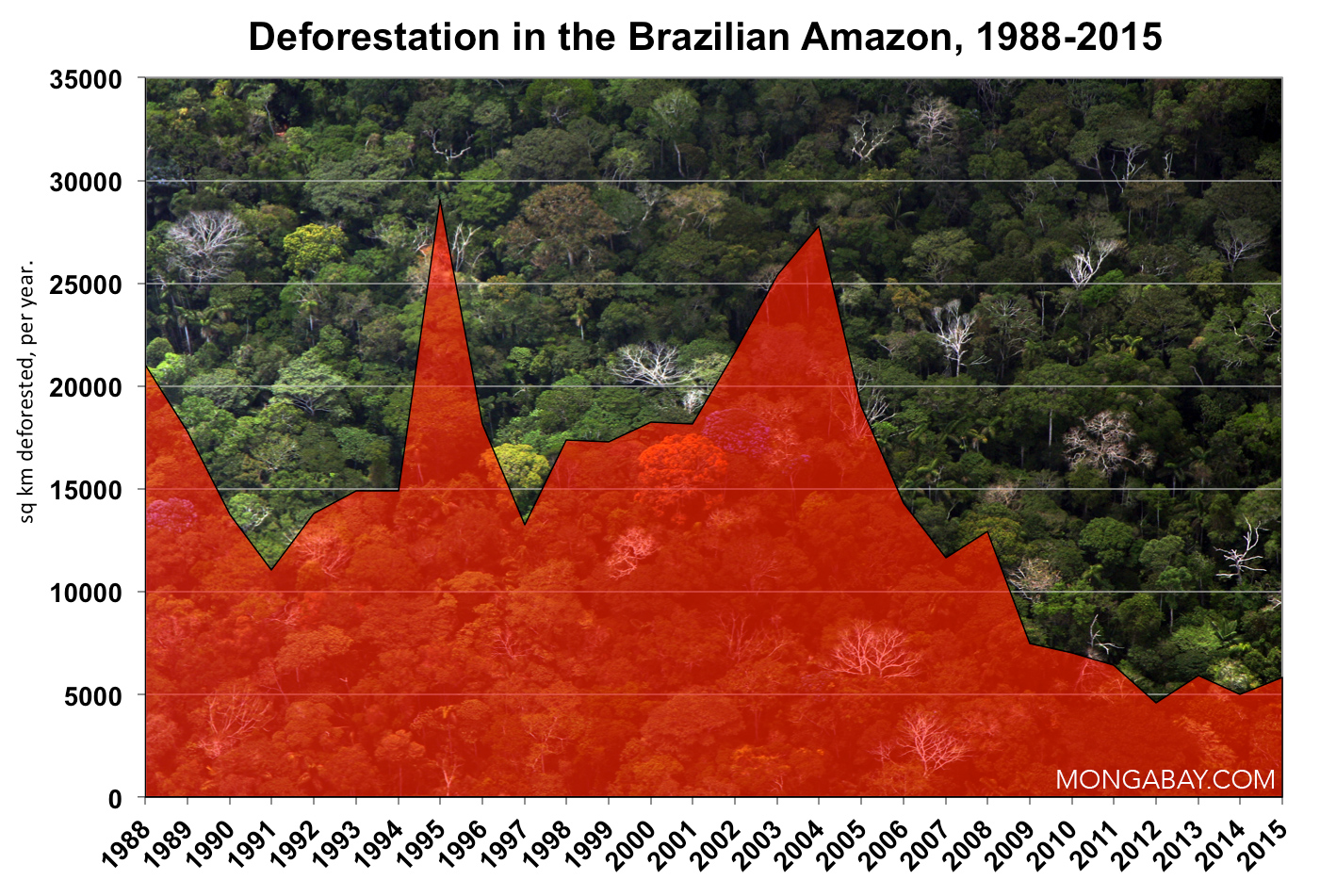
Since 2004 the rate of deforestation in the Brazilian Amazon has fallen nearly 80 percent to the lowest levels recorded since annual record keeping began in the late 1980s. Importantly, this decline has occurred at the same time that Brazil's economy has grown roughly 40 percent, suggesting a decoupling of economic growth from deforestation.

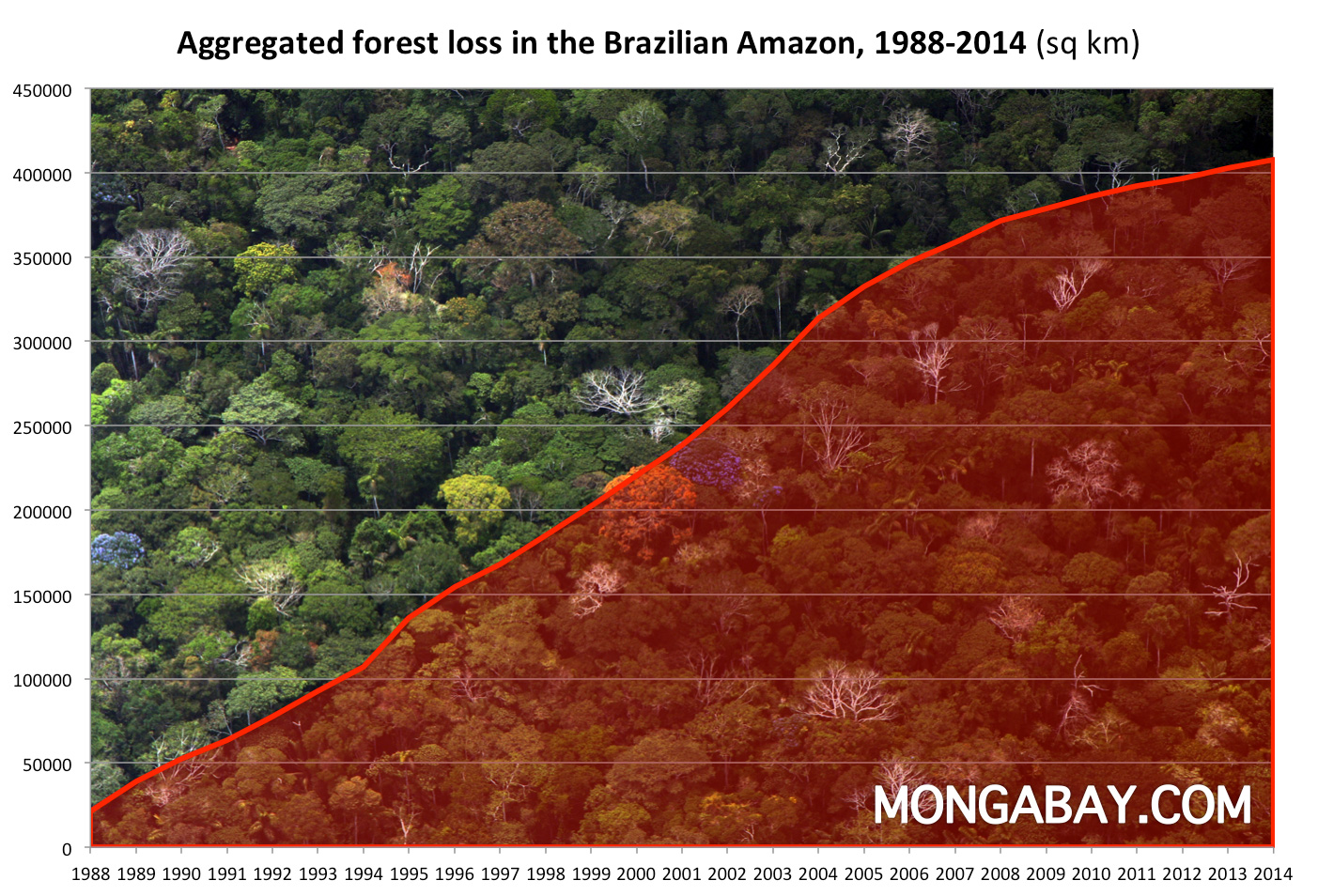
While this is welcome news for Earth's largest rainforest, it is nonetheless important to understand why more than 580,000 square kilometers (224,000 square miles) of Amazon forest has destroyed in Brazil since 1980. Why has Brazil lost so much forest? What can be done to stop deforestation?
Why is the Brazilian Amazon being Destroyed?

In the past, Brazilian deforestation was strongly correlated to the economic health of the country: the decline in deforestation from 1988-1991 nicely matched the economic slowdown during the same period, while the rocketing rate of deforestation from 1993-1998 paralleled Brazil's period of rapid economic growth. During lean times, ranchers and developers do not have the cash to expand their pasturelands and operations, while the government lacks funds to sponsor highways and colonization programs and grant tax breaks and subsidies to forest exploiters.

But this has all changed since the mid-2000s, when the link between deforestation and the broader Brazilian economy began to wane.

The reasons for the decline in Brazil's deforestation rate are debated, but most would agree that several factors come into play, including macroeconomic trends (a stronger Brazilian currency reduces the profitability of export-driven agriculture), increased enforcement of environmental laws, improved forest monitoring by satellite, new incentives for utilizing already deforested lands, expanded protected areas and indigenous reserves, heightened sensitivity to environmental criticism among private sector companies, and emerging awareness of the values of ecosystem services afforded by the Amazon.


A Closer Look at Brazilian Deforestation (Update: Future threats to the Amazon)

Like other places in the tropics, deforestation in Brazil is increasingly the result of urban consumption and trade rather than subsistence agriculture.

Today deforestation in the Amazon is the result of several activities, the foremost of which include:
  1. Clearing for cattle pasture
  2. Colonization and subsequent subsistence agriculture
  3. Infrastructure improvements
  4. Commercial agriculture
  5. Logging

Clearing for Cattle Pasture

Cattle ranching is the leading cause of deforestation in the Brazilian Amazon. This has been the case since at least the 1970s: government figures attributed 38 percent of deforestation from 1966-1975 to large-scale cattle ranching. Today the figure is closer to 60 percent, according to research by
Brazil's National Institute for Space Research (INPE) and its Agricultural Research Corporation (Embrapa). Most of the beef is destined for urban markets, whereas leather and other cattle products are primarily for export markets.

Brazil is today the world's largest exporter and producer of beef. Much of its expansion has taken place in the Amazon, which currently has more than 80 million head of cattle, up from 26.6 million in 1990 and equivalent to more than 85 percent of the total U.S. herd. The Brazilian Amazon has more than 214,000 square miles of pasture, an open space larger than France.

Several factors have spurred recent Brazil's growth as a producer of beef:
  • CURRENCY DEVALUATION—In the 1980s and 1990s the devaluation of the Brazilian real against the dollar effectively doubled the price of beef in reals and created an incentive for ranchers to expand their pasture areas at the expense of the rainforest. The weakness of the real also made Brazilian beef more competitive on the world market. But this has changed since 2004 as the real as strengthened, reducing the competitiveness of Brazilian beef overseas.
  • CONTROL OVER FOOT-AND-MOUTH DISEASE—The eradication of foot-and-mouth disease in much of Brazil has increased price and demand for Brazilian beef.
  • INFRASTRUCTURE—Road construction gives developers and ranchers access to previously inaccessible forest lands in the Amazon. Infrastructure improvements can reduce the costs of shipping and packing beef, while larger and more modern slaughterhouses have made cattle processing more efficient.
  • INTEREST RATES—Rainforest lands are often used for land speculation purposes. When real pasture land prices exceed real forest land prices, land clearing is a good hedge against inflation. At times of high inflation, the appreciation of cattle prices and the stream of services (e.g. milk) they provide may outpace the interest rate earned on money left in the bank.
  • LAND TENURE LAWS—In Brazil, colonists and developers have traditionally been able to gain title to Amazon lands by simply clearing forest and placing a few head of cattle on the land. As an additional benefit, cattle have historically been a low-risk investment relative to cash crops which are subject to wild price swings and pest infestations. Essentially cattle are a vehicle for land ownership in the Amazon and land cleared for pasture is generally significantly more valuable than forest land, facilitating land speculation.
  • CULTURAL TIES—Cattle ranching has a long history in the Brazilian Amazon and is as much a part of culture as an economic activity.


Colonization and subsequent subsistence agriculture

A significant amount of deforestation is caused by the subsistence activities of poor farmers who are encouraged to settle on forest lands by government land policies. In Brazil, each squatter acquires the right (known as a usufruct right) to continue using a piece of land by living on a plot of unclaimed public land and "using" it for at least one year and a day. After five years the squatter acquires ownership and hence the right to sell the land.

Poor farmers typically use fire for clearing land and every year satellite images pick up
tens of thousands of fires burning across the Amazon. Typically understory shrubbery is cleared and then forest trees are cut. The area is left to dry for a few months and then burned. The land is planted with crops like bananas, palms, manioc, maize, or rice. After a year or two, the productivity of the soil declines, and the transient farmers press a little deeper and clear new forest for more short-term agricultural land. The old, now infertile fields are used for small-scale cattle grazing or left for waste.

Between 1995 and 1998, the government granted land in the Amazon to roughly 150,000 families, but incentives for colonization have waned in recent years as the government has shifted support to larger entities and infrastructure projects.

Smallholders are sometimes used as a proxy by large development interests to gain access to land. In these cases poor migrants, usually from Brazil's Northeast, are paid by ranchers to occupy forest land (sometimes indigenous reservations or legal forest reserves belonging to other landowners). The ranchers eventually acquire the land from these squatters.


Infrastructure Improvements

Road construction in the Amazon leads to deforestation. Roads provide access to logging and mining sites while opening forest frontier land to exploitation by poor landless farmers.

Brazil's Trans-Amazonian Highway was one of the most ambitious economic development programs ever devised, and one of the most spectacular failures. In the 1970s, Brazil planned a 2,000-mile highway that would bisect the massive Amazon forest, opening rainforest lands to (1) settlement by poor farmers from the crowded, drought-plagued north and (2) development of timber and mineral resources. Colonists would be granted a 250-acre lot, six-months' salary, and easy access to agricultural loans in exchange for settling along the highway and converting the surrounding rainforest into agricultural land. The plan would grow to cost Brazil US$65,000 (1980 dollars) to settle each family, a staggering amount for Brazil, a developing country at the time.

The project was plagued from the start. The sediments of the Amazon Basin rendered the highway unstable and subject to inundation during heavy rains, blocking traffic and leaving crops to rot. Harvest yields for peasants were dismal since the forest soils were quickly exhausted, and new forest had to be cleared annually. Logging was difficult due to the widespread distribution of commercially valuable trees. Rampant erosion, up to 40 tons of soil per acre (100 tons/ha) occurred after clearing. Many colonists, unfamiliar with banking and lured by easy credit, went deep into debt.

Adding to the economic and social failures of the project, are the long-term environmental costs. After the construction of the Trans-Amazonian Highway, Brazilian deforestation accelerated to levels never before seen and vast swaths of forest were cleared for subsistence farmers and cattle-ranching schemes. The Trans-Amazonian Highway is a prime example of the environmental havoc that is caused by road construction in the rainforest.

Road construction and improvement continues in the Amazon today:
Paving of roads brings change in the Amazon rainforest and the Chinese economy drives road-building and deforestation in the Amazon


Commercial agriculture

Recently, soybeans have become one of the most important contributors to deforestation in the Brazilian Amazon. Thanks to a new variety of soybean developed by Brazilian scientists to flourish in rainforest climate, Brazil is on the verge of supplanting the United States as the world's
leading exporter of soybeans. High soybean prices have also served as an impetus to expanding soybean cultivation.

Philip Fearnside, co-author of a report in Science and member of Brazil's National Institute for Amazonian Research in Manaus, explains, "Soybean farms cause some forest clearing directly. But they have a much greater impact on deforestation by consuming cleared land, savanna, and transitional forests, thereby pushing ranchers and slash-and-burn farmers ever deeper into the forest frontier. Soybean farming also provides a key economic and political impetus for new highways and infrastructure projects, which accelerate deforestation by other actors."

Satellite data from 2004 showed a marked increase in deforestation along the BR-163 road, a highway the government has been paving in an effort to help soy farmers from Mato Grosso get their crops to export markets. Typically, roads encourage settlement by rural poor who look to the rainforest as free land for subsistence agriculture.


Logging

In theory, logging in the Amazon is controlled by strict licensing which allows timber to be harvested only in designated areas. However, there is significant evidence that illegal logging is quite widespread in Brazil. In recent years, Ibama—Brazil's environmental enforcement agency—has made several large seizures of illegally harvested timber including one in September 2003 when 17 people were arrested for allegedly cutting 10,000 hectares worth of timber.

Logging in the Amazon is closely linked with road building. Studies by the Environmental Defense Fund show that areas that have been
selectively logged are eight times more likely to be settled and cleared by shifting cultivators than untouched rainforests because of access granted by logging roads. Logging roads give colonists access to rainforest, which they exploit for fuelwood, game, building material, and temporary agricultural lands.
Other causes of forest loss in Brazil

Historically, hydroelectric projects have flooded vast areas of Amazon rainforest. The Balbina dam flooded some 2,400 square kilometers (920 square miles) of rainforest when it was completed. Phillip Fearnside, a leading expert on the Amazon, calculated that in the first three years of its existence, the Balbina Reservoir emitted 23,750,000 tons of carbon dioxide and 140,000 tons of methane, both potent greenhouse gases which contribute to global climate change. The Belo Monte dam now being built on the Xingu river is expected to drive regional deforestation by miners and industrial farmers, in addition to flooding tens of thousands of hectares of forest and impeding the flow of one of the mightiest tributaries of the Amazon.

Mining has impacted some parts of the Amazon Basin. During the 1980s, over 100,000 prospectors invaded the state of Para when a large gold deposit was discovered, while wildcat miners are still active in the state of Roraima near the Venezuelan border. Typically, miners clear forest for building material, fuelwood collection, and subsistence agriculture.


Fires

Virtually all forest clearing, by small farmer and plantation owner alike, is done by fire. Though these fires are intended to burn only limited areas, they frequently escape agricultural plots and pastures and char pristine rainforest, especially in
dry years like 2005. Many of the fires set for clearing forest for these purposes are set during the three-month burning season and the smoke produced creates widespread problems across the region, including airport closings and hospitalizations from smoke inhalation. These fires cover a vast area of forest. In 1987 during a four-month period (July-October), about 19,300 square miles (50,000 sq. km) of Brazilian Amazon were burned in the states of Parà, Rondonia, Mato Grosso, and Acre. The burning produced carbon dioxide containing more than 500 million tons of carbon, 44 million tons of carbon monoxide, and millions of tons of other particles and nitrogen oxides. An estimated 20 percent of fires that burn between June and October cause new deforestation, while another 10 percent is the burning of ground cover in virgin forests.

Fires and climate change are having a dramatic impact on the Amazon. Recent studies suggest that the Amazon rainforest may be losing its ability to stay green all year long as forest degradation and drought make it dangerously flammable. Scientists say that as much as 50 percent of the Amazon could go up in smoke should fires continue. Humidity levels were the lowest ever recorded in the Amazon in 2005.

Slavery and Violence in the Amazon

The Amazon has been a place of violence since at least the arrival of European explorers, and the present is no exception. Violent conflicts between large landowners, poor colonists, and indigenous groups over land are not unusual in the Amazon and may be worsening.

The Pastoral Land Commission, a nongovernmental group working in the region, found that land battles in Brazil's countryside reached the highest level in at least 20 years in 2004. According to the annual report by the organization, documented conflicts over land among peasants, farmers, and land speculators rose to 1,801 in 2004 from 1,690 conflicts in 2003 and 925 recorded in 2002. Tensions reached their peak earlier this year with the high-profile slaying of Dorothy Stang, an American nun who worked with rural poor, by gunmen associated with plantation owners. In response to the murder, the Brazilian government sent in the army to quell violence in the region and promised to step up environmental monitoring efforts.

The government has also stepped up efforts to end slavery in the Amazon. While Brazil officially abolished slavery in 1888, the government acknowledges that at least 25,000 Brazilians work under "conditions analogous to slavery," clearing land and working for cattle ranches, soy farms, and other labor-intensive industries. Some groups say the true figure could be ten times that amount. In 2005, 4,133 slaves were freed after Brazilian Swat-style teams raided 183 farms.

UPDATE: Future threats to the Amazon rainforest


What can de done to save the Amazon rainforest in Brazil?

Today Brazil faces an enormous challenge: how to balance economic growth with the preservation of the Amazon rainforest.
  1. Rehabilitation and increased productivity of formerly forested lands
  2. Expansion of protection areas
  3. Development based on concepts of sustainable use of some existing forest
  4. Land policy reform
  5. Law Enforcement


News on the Amazon Rainforest XML

Amazon's flood/drought cycle becoming more extreme, less predictable

(05/14/2013) The Amazon River's hydrological cycle has become more extreme over the past two decades with increasing seasonal precipitation across much of the basin despite drier conditions in the southern parts of Earth's largest rainforest, finds a new study published in Geophysical Research Letters. The research analyzed monthly Amazon River discharge at Óbidos, a point that drains 77 percent of the Amazon Basin, and compared it with regional precipitation patterns.


Deforestation will undercut effectiveness of rainforest dams

(05/13/2013) Deforestation may significantly decrease the hydroelectric potential of tropical rainforest regions, warns a new study published in Proceedings of the National Academy of Science. The study, used climate, hydrological, and land use models to forecast the impact of potential forest loss on hydropower generation on the Xingu River, a major tributary of the Amazon where the world's third largest dam — Belo Monte — is currently under construction.


Continued deforestation in the Amazon may kill Brazil's agricultural growth

(05/09/2013) Continuing deforestation in the Amazon rainforest could undermine agricultural productivity in the region by reducing rainfall and boosting temperatures, warns a new study published in the journal Environmental Research Letters.


Brazil's satellite monitoring reduced Amazon deforestation by 60,000 sq km in 5 years

(05/08/2013) Brazil's advanced satellite monitoring system, coupled with increased law enforcement, was responsible for nearly 60 percent of the 101,000 square kilometer-drop in deforestation observed between 2007 and 2011, argues a new study published an international think tank.


Debate heats up over California's plan to reduce emissions via rainforest protection

(05/07/2013) As the public comment period for California's cap-and-trade program draws to a close, an alliance of environmental activists have stepped up a heated campaign to keep carbon credits generated by forest conservation initiatives in tropical countries out of the scheme. These groups say that offsets generated under the so-called Reducing Emissions from Deforestation and Degradation (REDD+) mechanism, will undermine efforts to cut emissions as home, while potentially leading to abuses abroad. However supporters of forest conservation-based credits say the program may offer the best hope for saving the world's beleaguered rainforests, which continue to fall at a rate of more than 8 million hectares per year.


Unconventional swine: how invasive pigs are helping preserve biodiversity in the Pantanal

(05/06/2013) Ordinarily, invasive and exotic species are a grave threat to native wildlife: outcompeting local species, introducing parasites and disease, and disturbing local ecological regimes. A unique case in the Brazilian Pantanal, however, has turned the tables; here, an introduced mammal has actually aided the conservation of native wildlife.


Tribesmen launch 'occupy' protest at dam site in the Amazon rainforest

(05/03/2013) On Thursday roughly 200 indigenous people launched an occupation of a key construction site for the controversial Belo Monte dam in the Brazilian Amazon. The protestors, who represent communities that will be affected by the massive dam, are demanding immediate suspension of all work on hydroelectric projects on the Xingu, Tapajós and Teles Pires rivers until they are properly consulted, according to a coalition of environmental groups opposing the projects.


Is it possible to reduce the impact of oil drilling in the Amazon rainforest?

(05/02/2013) Oil extraction in the Amazon rainforest has been linked to severe environmental degradation — including deforestation and pollution — which in some areas has spurred violent social conflict. Yet a vast extent of the Colombian, Peruvian, Ecuadorian, Bolivian, and Brazilian Amazon is currently under concession for oil and gas exploration and production. It seems clear that much of this hydrocarbon development is going to proceed whether environmentalists and human rights groups like it or not.


Sugarcane production impacting local climate in Brazil

(05/01/2013) Intensification of Brazil's sugarcane industry in response to rising demand for sugar-based ethanol could have impacts on the regional climate reports a new study by researchers from Arizona State University, Stanford University and the Carnegie Institution for Science. Following the conversion of cerrado grasslands into sugarcane in Brazil, a recent study in Geophysical Research Letters found local cooling that approached 1 degree Celsius during the growing season and maximum local warming near 1 degree Celsius post-harvest.


Indigenous tribes say effects of climate change already felt in Amazon rainforest

(04/30/2013) Tribal groups in Earth's largest rainforest are already being affected by shifts wrought by climate change, reports a paper published last week in the British journal Philosophical Transactions of the Royal Society B. The paper, which is based on a collection of interviews conducted with indigenous leaders in the Brazilian Amazon, says that native populations are reporting shifts in precipitation patterns, humidity, river levels, temperature, and fire and agricultural cycles. These shifts, measured against celestial timing used by indigenous groups, are affecting traditional ways of life that date back thousands of years.


What if companies actually had to compensate society for environmental destruction?

(04/29/2013) The environment is a public good. We all share and depend on clean water, a stable atmosphere, and abundant biodiversity for survival, not to mention health and societal well-being. But under our current global economy, industries can often destroy and pollute the environment—degrading public health and communities—without paying adequate compensation to the public good. Economists call this process "externalizing costs," i.e. the cost of environmental degradation in many cases is borne by society, instead of the companies that cause it. A new report from TEEB (The Economics of Ecosystems and Biodiversity), conducted by Trucost, highlights the scale of the problem: unpriced natural capital (i.e. that which is not taken into account by the global market) was worth $7.3 trillion in 2009, equal to 13 percent of that year's global economic output.


Featured documentary: Damocracy, highlighting the battles over the Belo Monte and Ilisu dams

(04/29/2013) A new short documentary highlights the battles over monster dam projects imperiling local people and wild rivers. Examining the Belo Monte dam in Brazil and the Ilisu dam in Turkey, the documentary argues that such hydroelectric projects cannot be deemed "green" energy as they overturn lives, livelihoods, and ecosystems.


Amazon: the world's greatest rainforest or internet giant?

(04/25/2013) When you see the word "Amazon", what's the first thing that springs to mind—the world's biggest forest, the longest river or the largest internet retailer—and which do you consider most important? These questions have risen to the fore in an arcane, but hugely important, debate about how to redraw the boundaries of the internet. Brazil and Peru have lodged objections to a bid made by the US e-commerce giant for a prime new piece of cyberspace: ".amazon".


Frequent understory fires change rainforest community composition

(04/24/2013) Frequent understory fires change the composition of rainforest plant communities, potentially altering the capacity of forests to regenerate, finds a study published in special issue of the journal Philosophical Transactions of the Royal Society B.


Burned rainforest vulnerable to grass invasion

(04/24/2013) Rainforests that have been affected by even low-intensity fires are far more vulnerable to invasion by grasses, finds a new study published in special issue of the journal Philosophical Transactions of the Royal Society B. The findings are significant because they suggest that burned forests may be more susceptible to subsequent fires which may burn more intensely due to increased fuel loads.


Brazil's success in reducing deforestation will be hard to replicate

(04/23/2013) The sharp reduction in deforestation in the Brazilian state of Mato Grosso since the mid-2000s will be difficult to replicate in other tropical countries where commodity production is a major driver in forest loss, argues a new study published in a special issue of the journal Philosophical Transactions of the Royal Society B.


Brazil threatens $282m in fines for beef linked to Amazon deforestation

(04/17/2013) Federal prosecutors in Brazil are threatening to fine 26 beef producers $282 million for buying cattle raised in illegally deforested areas and on Indian reservations, reports Reuters.


Judge halts military-backed dam assessment in Brazil's Amazon

(04/17/2013) A federal court in Brazil has suspended the use of military and police personnel during technical research on the controversial São Luíz do Tapajós Dam in the Brazilian Amazon. The military and police were brought in to stamp down protests from indigenous people living along the Tapajós River, but the judge decreed that impacted indigenous groups must give free, prior, and informed consent (FPIC) before any furter studies can be done on the proposed dam. However, the decision is expected to be appealed.


New insect discovered in Brazil, only third known in its bizarre family (photos)

(04/15/2013) A new species of forcepfly named Austromerope brasiliensis, was recently discovered in Brazil and described in the open access journal Zoo Keys. This is the first discovery of forcepfly in the Neotropics and only the third known worldwide. The forcepfly, often called the earwigfly because the male genital forceps closely resemble the cerci of the common earwig, remains a scientific enigma due to the lack of information on the family.


New species tree-dwelling porcupine discovered in critically threatened Brazilian habitat

(04/11/2013) Scientists in Brazil have described a new species of tree-dwelling porcupine in the country's most endangered ecosystems. The description is published in last week's issue of Zootaxa.


Landowner who allegedly ordered Amazon murders acquitted

(04/10/2013) Jose Rodrigues Moreira, a Brazilian landowner who allegedly ordered the killings of Amazon activists Jose Claudio Ribeiro da Silva and his wife Maria, was acquitted this week due to lack of evidence. But, the two men who carried out the assassinations, Lindonjonson Silva Rocha and Alberto Lopes do Nascimento, were found guilty and sent to 42 and 45 years of jail respectively.


6 lessons for stopping deforestation on the frontier

(04/09/2013) In 1984, at the tail end of the Brazilian dictatorship, I took up residence in a frontier town called Paragominas in the eastern Amazon. I went to study rainforests and pasture restoration, but soon became captivated as well by the drama of the frontier itself. Forests were hotly contested among cattle ranchers, smallholder communities, land speculators and more than a hundred logging companies, sometimes with fatal results. If we are to meet rising global demand for food, conserve tropical forests, and mitigate climate change at the pace that is necessary, we must become much better at taming aggressive, lawless tropical forest frontiers where people are making a lot of money cutting forests down.


Featured video: stemming human-caused fires in the Amazon

(04/09/2013) A new series of 5 films highlights how people use fire in the Amazon rainforest and how such practices can be mitigated. Collectively dubbed "Slash & Burn" each film explores a different aspect of fire-use in the Amazon. In recent years the Amazon has faced unprecedented droughts, possibly linked to climate change and vast deforestation, making the issue of human-started fires even more important.


Indigenous group: Brazil using military to force Amazon dams

(04/08/2013) An Amazonian community has threatened to "go to war" with the Brazilian government after what they say is a military incursion into their land by dam builders. The Munduruku indigenous group in Para state say they have been betrayed by the authorities, who are pushing ahead with plans to build a cascade of hydropower plants on the Tapajós river without their permission.


30% of Brazil's emissions from deforestation are export-driven

(04/05/2013) 2.7 billion tons of carbon dioxide emissions or 30 percent of the carbon associated with deforestation in the Brazilian Amazon between 2000 and 2010 was effectively exported in the form of beef products and soy, finds a new study published in the journal Environmental Research Letters. The research underscores the rising role that global trade plays in driving tropical deforestation.


News on the Amazon Rainforest XML


Causes and Effects of Deforestation
Causes of Deforestation
A World Imperiled
Natural Threats
Threats from Humankind
Subsistence Activities
Economic Restructuring
Oil Extraction
Logging
Mining
Fires
War
Commercial Agriculture
Cattle Pasture
Hydro, Pollution, Hunting
Fuelwood, Roads, Climate
Debt
Population & Poverty
Consumption, Conclusion
Effects of Deforestation
Consequences of Deforestation
Local Effects
Erosion
Loss of Species, Disease
Loss of Renewable Resources
Climactic Role
Atmospheric Role
Extinction

Rainforest Photos [TOUR]
Australia pictures
Belize
Brazil
Costa Rica
Gabon Pictures
Honduras Pictures
Indonesia
Madagascar Pictures
Malaysia
Panama Pictures
Peru
Thailand Pictures
Uganda Pictures
Venezuela Pictures
Addressing Deforestation
Solutions Introduction
Sustainable Development
Sustainable Forest Products
Eco-tourism
Large-scale Forest Products
Foods & Genetic Diversity
Medicinal Drugs
Medicinal Drugs & Pesticides
Logging
Logging (con't)
Logging (con't)
Cattle
Oil
Increasing Productivity
Conservation Priorities
Types of Reserves
Reserve Size & Valuation
Funding
Organization
Developing nations
Intergovernmental Institutions
NGOs
Communication, Education
International Organizations
Indigenous people
Conclusion


THE AMAZON RAINFOREST


what's new | tropical fish | help support the site | search | about | contact

Copyright Rhett Butler 1994-2010