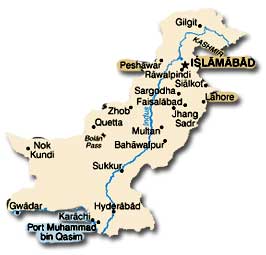
Click to Enlarge Imagen
GEOGRAPHY
Location: Located in South Asia, Pakistan borders Iran to
the southwest, Afghanistan to the west and north, China to
the northeast, and India to the east. The Arabian Sea marks
Pakistan’s southern boundary.
Size: Pakistan’s exact size is debated because of its disputed
border with India. According to the United Nations and the
Pakistan government, the country has a total area of 796,095
square kilometers. This figure, however, does not include the
Pakistan-administered portions of Jammu and Kashmir (know
as Azad Kashmir and the Northern Areas, with areas of 11,639
square kilometers and 72,520 square kilometers, respectively). These areas are claimed by Pakistan, but because their possession is disputed, they are not included in official land area statistics.
Land Boundaries: Pakistan shares borders with Afghanistan (2,430 kilometers), China (523 kilometers), India (2,912 kilometers), and Iran (909 kilometers).
Disputed Territory: Afghanistan disputes the legitimacy of its border with Pakistan, and at times Afghanistan’s governments have argued that all Pashtun (Pakhtun) territory in Afghanistan and Pakistan should be under Afghan control. Pakistan and India have disputed possession of Jammu and Kashmir since 1947, and the issue remains unresolved despite numerous cease-fire agreements between the two countries. Jammu and Kashmir is split between the two countries by a United Nations-monitored border called the Line of Control.
Click to Enlarge Imagen
Length of Coastline: Pakistan’s coastline totals 1,064 kilometers along the Arabian Sea.
Maritime Claims: Under the 1982 United Nations Convention on the Law of the Sea, Pakistan claims a 200-nautical-mile exclusive economic zone, a 12-nautical-mile territorial sea, and a 24-nautical-mile contiguous zone for security, immigration, customs, and other matters.
Topography: Pakistan has a diverse array of landscapes spread among nine major ecological zones. Its territory encompasses portions of the Himalaya, Hindu Kush, and Karakoram mountain ranges, making it home to some of the world’s highest mountains, including K2, which at 8,611 meters above sea level is the world’s second highest peak. Intermountain valleys make up much of the North-West Frontier Province, and rugged plateaus cover much of Balochistan Province in the west. In the east, expansive, irrigated plains along the Indus River cover much of of Punjab and Sindh provinces, which have deserts as well (Cholistan in Punjab, Thar in Sindh).
Principal Rivers: The main rivers are the Indus (2,749 kilometers within Pakistan) and its tributaries: the Chenab (730.6 kilometers), Ravi (680.6 kilometers), Jhelum (611.3 kilometers), and Sutlej (530.6 kilometers). The navigable portions of these rivers are generally small and unconnected as a result of seasonal variations in water flows and the presence of substantial irrigation structures.
Climate: Most of Pakistan has a generally dry climate and receives less than 250 millimeters of rain per year, although northern and southern areas have noticeable climatic differences. The average annual temperature is around 27°C, but temperatures vary with elevation from –30°C to –10°C during the coldest months in mountainous and northern areas of Pakistan-administered Kashmir to 50°C in the warmest months in parts of Punjab, Sindh, and the Balochistan Plateau. Mid-December to March is dry and cool; April to June is hot, with 25 to 50 percent relative humidity; July to September is the wet monsoon season; and October-November is the dry post-monsoon season, with hot temperatures nationwide.
Natural Resources: Economically important natural resources include arable land, chromite, coal, copper, fireclay, gypsum, iron, limestone, oil, natural gas, rock salt, and silica sand.
Land Use: More than 40 percent of the working population is employed in agriculture, yet the per capita amount of agricultural land is declining, and there are significant natural limitations to increasing the quantity of arable land. According to official statistics for 2004, the country’s total land area is 79.6 million hectares, but only 59.3 million hectares have been surveyed. Out of the surveyed land area, 24.6 million hectares are classified as not available for cultivation, 3.6 million hectares are forest area, and 9.2 million hectares are unused but believed to be cultivable. Approximately 22 million hectares are used for cultivation, of which nearly 16 million hectares are actually sown, with the remainder left fallow. About 13.5 million hectares of the sown area are irrigated, and 6.5 million hectares are sown more than once per year. Most cultivable and irrigated land is located in the eastern provinces of Punjab and Sindh around the Indus River and its tributaries. Pakistan has an extensive but inefficient canal system for irrigation, and much of the crop area is rain fed, but precipitation tends to be unevenly distributed throughout the year.
Environmental Factors: Numerous environmental problems threaten the economy and the population’s health, and there is little indication of their abatement. A 1997 World Bank study estimated the annual cost of Pakistan’s environmental problems at US$1.8 billion in health expenditures, reduced labor productivity, and other costs. The availability of natural resources is limited by the dry climate and mountainous terrain, substantial population growth is increasing pressure on the resource base, and resource management has suffered from the emphasis on rapid economic growth and often-unregulated forms of economic productivity. As a result, human transformation of the environment is manifest in several problems. Population growth and poor water infrastructure have reduced per capita water availability from 53,000 cubic meters to 1,200 cubic meters, and heavy reliance on firewood has contributed to the world’s second highest rate of deforestation. Poor agricultural practices have led to soil erosion, groundwater degradation, and other problems that have hindered crop output and contributed to health problems for rural communities. Solid waste burning, low-quality fuels, and the growing use of fuel-inefficient motor vehicles have contributed to air pollution that in some cities—such as Islamabad, Lahore, and Rawalpindi—has exceeded levels deemed safe by the World Health Organization.
The government has expressed concern about environmental threats to economic growth and social development and, since the early 1990s, has addressed environmental concerns with new legislation and institutions such as the Pakistan Environment Protection Council. Yet, foreign lenders provide most environmental protection funds, and only 0.04 percent of the government’s development budget goes to environmental protection. Thus, the government’s ability to enforce environmental regulations is limited, and private industries often lack funds to meet environmental standards established by international trade organizations.
Time Zone: Pakistan is in a single time zone, Greenwich Mean Time plus 5.5 hours.