|
![]() |
|
|
Afghanistan: GEOGRAPHY
GEOGRAPHY
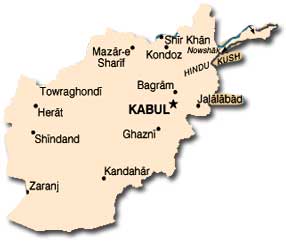
Location: Afghanistan is located in Central Asia, north and west of Pakistan, east of Iran, and south of Turkmenistan, Uzbekistan, and Tajikistan. The narrow Wakhan Corridor extends from northeasternmost Afghanistan to meet with China.
Size: Afghanistan occupies approximately 647,500 square kilometers, slightly less than Texas.
Land Boundaries: Afghanistan has borders with the following countries: China, 76 kilometers; Iran, 936 kilometers; Pakistan, 2,430 kilometers; Tajikistan, 1,206 kilometers; Turkmenistan, 744 kilometers; and Uzbekistan, 137 kilometers.
Disputed Territory: Afghanistan has no boundary disputes; ongoing incursions, smuggling, and terrorist movement across the Pakistan border are addressed in regular bilateral meetings.
Length of Coastline/Maritime Claims: Afghanistan is landlocked.
Topography: The terrain of Afghanistan is dominated by rugged mountain ranges, which generally run from the northeast to the southwest. Mountains occupy all but the north-central and southwestern regions of the country, which are dominated by plains. Nearly half the country has an elevation of 2,000 meters or more, and the highest peaks in the northeastern Hindu Kush range exceed 7,000 meters. Historically, mountain passes along the northeastern border with present-day Pakistan have been of great strategic importance. Significant parts of the southwestern plains region are desert.
Principal Rivers: The main rivers are the Amu Darya, 800 kilometers; the Harirud, 850 kilometers; the Helmand, 1,000 kilometers; and the Kabul, 460 kilometers. Afghanistan’s chief tributaries to the Amu Darya, which forms much of the country’s northern border, are the Koshk and the Qonduz.
Click to Enlarge Image Climate: Afghanistan’s climate generally is of the arid or semi-arid steppe type, featuring cold winters and dry, hot summers. The mountains of the northeast have subarctic winter conditions. Farther south, monsoon effects moderate the climate near the Pakistan border and increase rainfall as far inland as central Afghanistan. The highest precipitation occurs in the Kabul region of the northeast. The highest temperatures and lowest precipitation are in the southwestern plains region, where summer temperatures reach 49° C. Low temperatures in the northeastern mountains range from –15° C in winter to 0° C in summer. The climate of the north-central Turkistan Plain is increasingly arid closest to the northern borders with Turkmenistan, Uzbekistan, and Tajikistan.
Natural Resources: Agricultural resources are primarily grazing land; fertile crop-growing land is concentrated in Kondoz Province in the north and Helmand Province in the south. Afghanistan is known to have major deposits of chrome, coal, copper, iron, and salt, as well as lesser amounts of a wide variety of minerals including gold, silver, and uranium. Natural gas is the most abundant hydrocarbon resource. Substantial oil deposits are recognized but not yet quantified. Water for all purposes is in critically short supply.
Land Use: Some 12.1 percent of Afghanistan’s land is classified as arable; however, in the early 2000s a four-year drought cut that figure in half. In 2005 only 0.2 percent of the total was planted to permanent crops.
Environmental Factors: Although little studied before recent times, the environment of Afghanistan is assumed to have been spared large-scale disturbances until the Soviet invasion of 1979. Since that time, however, numerous events have caused severe damage. Afghanistan, which has no appreciable bodies of water, suffers from a limited freshwater supply that makes potable water unavailable to more than half the population. In recent years, groundwater quality has deteriorated because of agricultural and industrial runoff, and water quantity has been diminished by large-scale land clearing and desertification. Because of insufficient water treatment, the incidence of water-borne diseases is very high. Widespread overgrazing, soil erosion, salinization, and waterlogging have reduced agricultural productivity. Although Afghanistan has little industry, particulate pollutants from the Aral Sea and industrial complexes in Iran, Turkmenistan, and Uzbekistan contaminate the atmosphere in northern Afghanistan. Chemical use and physical destruction in recent military conflicts have damaged the environment, and landmines and unexploded shells are residual hazards endangering an estimated 4 million Afghanis in 32 provinces.
Time Zone: Afghanistan is four and one-half hours ahead of Greenwich Mean Time.
RECENT NEWS ARTICLES Online - International News Network,NEW DELHI’: India will host next month a crucial conference of countries contributing to reconstruction and development of Afghanistan. ... US urges Germany to extend mandate in Afghanistan - 24 Oct 2006 Reuters AlertNet,BERLIN, Oct 23 (Reuters) - Germany should consider extending its Afghanistan mandate to allow its troops to move to the south of the country, where other NATO ... Meet on Afghanistan in New Delhi next month - 24 Oct 2006 Zee News,New Delhi, Oct 23: India will host next month a crucial conference of countries contributing to reconstruction and development of Afghanistan. ... Prison sentence for Dutch soldier refusing to serve in Afghanistan - 24 Oct 2006 Khaleej Times,THE HAGUE - Dutch prosecutors on Monday asked for a four-month prison sentence for a 21-year-old soldier who has refused to serve in Afghanistan, the ANP news ... Gross stupidity in Afghanistan - 24 Oct 2006 Asia Times Online,The US-led coalition is unambiguously losing the war in Afghanistan, and it is important, at this stage, to reiterate the obvious, that is, precisely why the ... Underwood soldier serving in Afghanistan - 24 Oct 2006 Shoreline Beacon,Fischer is in Afghanistan stationed at Kandahar Air Force Base with the Canadian Armed Forces. ... On-going news concerning Afghanistan is important to the family. ... Afghanistan NATO’s most important task - 24 Oct 2006 Online - International News Network,OSLO: Foreign Minister Jonas Gahr Stoere says that Norway supports NATO and other allies in the view that Afghanistan must be seen as NATO’s most important ... Opposition grills government over Afghanistan - 24 Oct 2006 Aftenposten,...of the two main opposition parties in the Norwegian Parliament grilled government ministers on Tuesday over their refusal to send more troops to Afghanistan. ... Other local casualties in Iraq and Afghanistan - 24 Oct 2006 Daytona Beach News-Journal,2 near Korengal, Afghanistan, when his unit encountered enemy forces as it tried to recover casualties from a firefight earlier that day. ... Can Afghanistan Get All its Girls in School ? - 24 Oct 2006 World Bank Group,Since the fall of the Taliban regime in Afghanistan, the country has experienced a dramatic increase in school enrolment, particularly for girls. ... Canada's sudden Afghan burnout - 24 Oct 2006 Toronto Star,...suggested last week that the military might have to "re-role" some trainee soldiers from their preferred jobs to serve as infantry in Afghanistan, the Halifax ... Dumb and dumber - 24 Oct 2006 Toronto Star,...who added snafu to the vernacular are now looking for other ways to relieve unsustainable pressure on an army Stephen Harper committed to Afghanistan until 2009 ... War takes heavy toll on NS - 24 Oct 2006 Toronto Star,HALIFAX—If blood is the price for stabilizing Afghanistan, then Nova Scotians have picked up a hefty chunk of the tab. Seven of ... 3rd BCT making progress in Afghanistan - 24 Oct 2006 News 10 Now,Commander of the 10th Mountain Division's 3rd Brigade Combat Team says US troops are making progress in Afghanistan. Colonel John ... Support for Canuck mission waning - 24 Oct 2006 Calgary Sun,EDMONTON -- A military wife says support for the war in Afghanistan is waning in Edmonton, and an Ontario father fears the stagnant mission means more troops ... Afghanistan and Pakistan to hold jirgas - 24 Oct 2006 United Press International...with Bush to convene "jirgas," or councils of tribal elders, on both sides of the border to seek their assistance in ending the rising violence in Afghanistan. ... India, Russia discuss opium terror, Al Qaeda - 24 Oct 2006 Telugu Portal,New Delhi, Oct 24 (IANS) Drug financing of terror groups in Afghanistan and the threat potential of Al Qaeda modules in the subcontinent figured prominently in ... This series of profiles of foreign nations is part of the Country Studies Program, formerly the Army Area Handbook Program. The profiles offer brief, summarized information on a country’s historical background, geography, society, economy, transportation and telecommunications, government and politics, and national security. In addition to being featured in the front matter of published Country Studies, they are now being prepared as stand-alone reference aides for all countries in the series, as well as for a number of additional countries of interest. The profiles offer reasonably current country information independent of the existence of a recently published Country Study and will be updated annually or more frequently as events warrant. |
| what's new | rainforests home | help support the site | madagascar | search | about | contact |
Copyright Rhett Butler 1994-2006 |