COUNTRY PROFILES
 Home
 What's New
 About
 Contribute
 Submissions
 Rainforests
 Profiles
   Afghanistan
   Algeria
   Australia
   Bolivia
   Bulgaria
   China
   Colombia
   Eritrea
   Ethiopia
   Germany
   Haiti
   India
   Indonesia
   Iran
   Iraq
   Kazakhstan
   Kenya
   Kyrgyzstan
   Libya
   Morocco
   Nepal
   Nigeria
   North Korea
   Pakistan
   Paraguay
   Philippines
   Romania
   Russia
   Saudi Arabia
   Singapore
   South Korea
   Sudan
   Syria
   Taiwan
   Thailand
   Turkey
   Turkmenistan
   UAE
   Uzbekistan
   Venezuela
   Vietnam
   Yemen
 Deforestation Stats
 Pictures
 Books
 Links
 Site Map
 Mongabay Sites
   Kids' site
   Travel Tips
   Tropical Fish
   Madagascar
 Reference
 Contact


Saudi Arabia: GEOGRAPHY


GEOGRAPHY

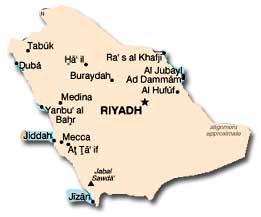
Location: Saudi Arabia is located in the Middle East, occupying

about 80 percent of the Arabian Peninsula.

Size: The land area is estimated at between 2,149,690 and 2,240,000

million square kilometers—approximately one-fifth the area of the

continental United States. Border disputes and undemarcated borders

make determining the exact size of the country difficult.

Land Boundaries: Saudi Arabia has a total of 4,431 kilometers of borders with Yemen (1,458 kilometers), Iraq (814 kilometers), Jordan (744 kilometers), Oman (676 kilometers), the United Arab Emirates (457 kilometers), Kuwait (222 kilometers), and Qatar (60 kilometers).

Disputed Territory: Only portions of the border with Yemen, demarcated in 1934, are clearly defined. The discovery of new oil repositories in the 1990s led to border disputes between Saudi Arabia and both Yemen and Jordan, some of which were resolved in the early 1990s. However, conflicts over national borders persist in the Arabian Peninsula.

Length of Coastline: Saudi Arabia has 2,640 kilometers of coastline—nearly 1,800 kilometers along the Gulf of Aqaba and the Red Sea and the remainder along the Persian Gulf.

Maritime Claims: Saudi Arabia claims a territorial sea of 12 nautical miles and a contiguous zone of 18 nautical miles. Saudi Arabia also claims some small islands, seabed, and subsoils beyond the 12 nautical mile limit.

Topography: The Arabian Peninsula is an ancient massif composed of stable crystalline rock whose geologic structure developed concurrently with the Alps. Geologic movements caused the entire mass to tilt eastward and the western and southern edges to tilt upward. In the valley created by the fault, called the Great Rift, the Red Sea was formed. On the Arabian Peninsula, the eastern line of the Great Rift fault is visible in the high escarpment that parallels the Red Sea between the Gulf of Aqaba and the Gulf of Aden. The eastern slope of the escarpment is relatively gentle. A second, lower escarpment, the Jabal Tuwayq, runs north to south through the area of Riyadh. In the south, a coastal plain rises gradually from the sea to the mountains. The central plateau, Najd, extends east to the Jabal Tuwayq and slightly beyond. A long, narrow strip of desert known as Ad Dahna separates Najd from eastern Arabia, which slopes eastward to the sandy coast along the Persian Gulf. North of Najd, a larger desert, An Nafud, isolates the heart of the peninsula from the steppes of northern Arabia. South of Najd lies one of the largest sand deserts in the world, the Rub al Khali.

Click to Enlarge Image

Principal Rivers: Saudi Arabia has no permanent rivers. However, in eastern Arabia, artesian wells and springs provide valuable water resources. Additionally, in many areas of northern and eastern Arabia significant underground aquifers lie beneath the Saudi desert. The largest of these aquifers, the Wasia, contains more water than the entire Persian Gulf.

Climate: The climate in Saudi Arabia differs between two distinct regions: the coast and the interior. Arid and extreme temperatures characterize the interior, and high humidity coupled with more moderate temperatures is prevalent along the coast. Temperatures along the coast rarely rise above 38° C. There is often mist during the day and a warm fog at night. Late spring and early summer in the coastal regions bring the windy season. The interior of Saudi Arabia is composed of desert regions with extreme temperatures. The average daytime temperature in the summer is 45° C, but it is not uncommon for temperatures to reach 54° C. Winter nights can get relatively cold, but temperatures rarely drop below freezing. Most of Saudi Arabia receives only infrequent rainfall. However, the southwestern province of Asir experiences monsoons between the months of May and October, when an average of 300 millimeters of precipitation falls.

Natural Resources: Saudi Arabia’s vast oil resources have shaped the kingdom’s development. The country also has large natural gas reserves, as well as deposits of bauxite, coal, copper, gold, iron, phosphates, platinum, silver, tungsten, uranium, and zinc. Non-mineral resources include limestone, glass sand, and stone.

Land Use: Most of Saudi Arabia consists of arid or semi-arid land. According to 2001 statistics, only 1.67 percent of Saudi land can be classified as arable, and only 0.09 percent of land was planted with permanent crops. Irrigated land totaled an estimated 16,200 square kilometers in 1998. In the more temperate regions of the kingdom, adequate forage exists to support cattle grazing.

Environmental Factors: Saudi Arabia faces numerous environmental challenges. In addition to having very little arable land, desertification and creeping sands are a concern, as is water scarcity. The lack of perennial rivers or permanent bodies of water poses a continual challenge, as does the depletion of underground water resources. Additionally, coastal oil spills, though infrequent, contribute to pollution.

Time Zone: Saudi Arabia operates on Greenwich Meantime plus 3 hours.


RECENT NEWS ARTICLES

Oxford Business Group appoints Saudi Arabia Country Director
16 Aug 2006 - AME Info,
...and the name behind the authoritative Emerging Markets series, has appointed Michelle Solomon as its Senior Country Director in Saudi Arabia - the first ...

Ford supplements service campaign in Saudi Arabia
Aug 14, 2006 - AME Info,
Last year, the service campaign involved 960 units across Saudi Arabia, and included 2000 model year Ford F-150, Expedition and certain 2001 model year F-150 ...

How cell phones changed courting in Saudi Arabia
Aug 13, 2006 - San Francisco Chronicle,
...(08-13) 04:00 PDT Jidda, Saudi Arabia -- Three am, two luxury cars side by side on an empty street, slicing through the sticky seaside air at 100 mph. ...

TNT to invest USD 1 million in Saudi Arabia
Aug 12, 2006 - AME Info,
TNT Express, the world's leading B2B express delivery company, will invest over USD 1 million to expand its services in Saudi Arabia. ...

Saudi Arabia sends humanitarian aid to Lebanon
Aug 13, 2006 - Monsters and Critics.com,
Dubai - Saudi Arabia on Sunday sent a fleet of 30 trucks with humanitarian aid, including 660 tons of foodstuffs and medical supplies, for Lebanon, the Saudi ...

Saudi Arabia Welcomes Turkey's Support To Palestine, King Abdullah
Aug 14, 2006 - Turkish Press,
ISTANBUL - Saudi Arabia welcomes Turkey's efforts to support Palestine and to find a fair solution to Arabian-Israeli clash, King Abdullah bin Abdul Aziz al ...

TNT to invest $1 million in Saudi Arabia
Aug 12, 2006 - Strategiy,
TNT Express, the world’s leading B2B express delivery company, will invest over US$ 1 million to expand its services in Saudi Arabia. ...

Saudi Arabia Airlines to privatize catering division
Aug 13, 2006 - Middle East North Africa Financial Network,
...(MENAFN) Saudi Arabian Airlines kicked off the long-awaited bidding process for a stake of up to 49 percent of its catering division, Arab News reported. ...

Saudi Arabia's Rawabi Telecom Selects Pactolus Communications ...
Aug 15, 2006 - VoIP Magazine (press release),
Service Creation Environment by Rawabi Telecom and Software (RTS), a subsidiary of Rawabi Holding Company, one of the Kingdom of Saudi Arabia's largest and ...

Cops call on job-seekers to Saudi Arabia
Aug 10, 2006 - Times of India,
MUMBAI: The families of three engineers, who have been to Saudi Arabia in the recent past "to look for jobs", have been called to police stations and asked to ...

Turkey and Saudi Arabia Sign 6 Deals
Aug 9, 2006 - Zaman Online,
Sezer later held an official welcoming ceremony for the King at the Cankaya Presidential Palace, where he stressed that Turkey sees Saudi Arabia “a stable ...

Indian missing in Saudi Arabia
Aug 11, 2006 - Daily News & Analysis,
DUBAI: Saudi Arabian authorities have launched a search operation for an Indian man who went missing in the Kingdom on Tuesday. ...

Turkey courts Saudi Arabia
Aug 11, 2006 - Miami Herald,
Turkey's prime minister shifts his attention from Europe to Saudi Arabia for increasing economic cooperation between the two countries. BY SUZAN FRASER. ...

Saudi Arabia , Turkey Set to Boost Trade Ties
Aug 10, 2006 - Middle East North Africa Financial Network,
ISTANBUL, 11 August 2006 — Saudi Arabia and Turkey set out a new vision of economic relations yesterday during a business meeting here jointly chaired by ...

Saudi Arabia may not need to ‘make up for Alaska loss’
Aug 9, 2006 - Gulf Times,
LONDON: Oil power Saudi Arabia stands willing to make up lost supplies from BP’s closure of its giant Alaskan oilfield, but it may not need to. ...

Saudi Arabia would be pleased to see aid useful
Aug 9, 2006 - Antara,
Banda Aceh (ANTARA News) - Saudi Arabia is pleased to have been able to help tsunami victims in Aceh and will be happier if its humanitarian aid is used ...

Move to open up aviation sector in Saudi Arabia for foreign ...
Aug 10, 2006 - Middle East North Africa Financial Network,
JEDDAH — There is a move to open up investment in the aviation sector in Saudi Arabia to foreign companies. The General Authority ...

Saudi Arabia, Singapore to enhance education ties
Aug 10, 2006 - Middle East North Africa Financial Network,
Singapore's Minister of Education showed, during a seminar attended by students from Saudi Arabia, China, Japan, Singapore and Malaysia, that they want to ...


This series of profiles of foreign nations is part of the Country Studies Program, formerly the Army Area Handbook Program. The profiles offer brief, summarized information on a country’s historical background, geography, society, economy, transportation and telecommunications, government and politics, and national security. In addition to being featured in the front matter of published Country Studies, they are now being prepared as stand-alone reference aides for all countries in the series, as well as for a number of additional countries of interest. The profiles offer reasonably current country information independent of the existence of a recently published Country Study and will be updated annually or more frequently as events warrant.


Google
 
Web www.mongabay.com
what's new | rainforests home | help support the site | madagascar | search | about | contact

Copyright Rhett Butler 1994-2006