COUNTRY PROFILES
 Home
 What's New
 About
 Contribute
 Submissions
 Rainforests
 Profiles
   Afghanistan
   Algeria
   Australia
   Bolivia
   Bulgaria
   China
   Colombia
   Eritrea
   Ethiopia
   Germany
   Haiti
   India
   Indonesia
   Iran
   Iraq
   Kazakhstan
   Kenya
   Kyrgyzstan
   Libya
   Morocco
   Nepal
   Nigeria
   North Korea
   Pakistan
   Paraguay
   Philippines
   Romania
   Russia
   Saudi Arabia
   Singapore
   South Korea
   Sudan
   Syria
   Taiwan
   Thailand
   Turkey
   Turkmenistan
   UAE
   Uzbekistan
   Venezuela
   Vietnam
   Yemen
 Deforestation Stats
 Pictures
 Books
 Links
 Site Map
 Mongabay Sites
   Kids' site
   Travel Tips
   Tropical Fish
   Madagascar
 Reference
 Contact


Indonesia: GEOGRAPHY


GEOGRAPHY

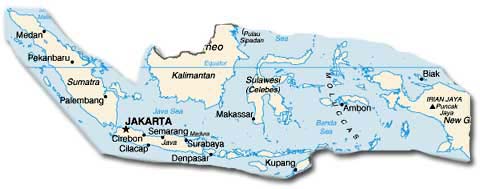
Location: Indonesia is located in Southeast Asia. The

approximate geographic center is at 5ES and 120EE. It

lies between the Indian and Pacific oceans and between

the continents of Asia and Australia, south of Malaysia

and the Philippines, and northwest of Australia.

Size: Estimates of the size of Indonesia’s total area vary. Officially, the Indonesian government says the total land area is 1.9 million square kilometers and total sea area, 7.9 million square kilometers, including an exclusive economic zone. Academic sources report a total land area of 2,027,087 square kilometers plus 3,166,163 square kilometers of territorial waters and note that the country measures about 5,100 kilometers at its greatest east-west extent, and about 1,888 kilometers at its greatest expanse north to south. According to U.S. Government sources, Indonesia has 1,826,440 square kilometers of land, some 93,000 square kilometers of water area (the sum of all water surfaces delimited by international boundaries and/or coastlines, including inland water bodies, such as lakes, reservoirs, and rivers) for a total area of 1,919,440 plus a 7.9 million-square-kilometer maritime area.

Land Boundaries: Indonesia’s land boundaries total 1,758 kilometers, including 1,107 kilometers with Malaysia, 820 kilometers with Papua New Guinea, and 288 kilometers with East Timor.

Length of Coastline: Indonesia’s coastline totals 54,716 kilometers on the Indian Ocean, Strait of Malacca, South China Sea, Java Sea, Sulawesi Sea, Maluku Sea, Pacific Ocean, Arafura Sea, Timor Sea, and other smaller seas.

Click to Enlarge Image

Maritime Claims: Indonesia claims a 12-nautical-mile territorial sea and a 200-nautical-mile exclusive economic zone, measured from claimed archipelagic straight baselines. The total area claimed by the Indonesian government, including Indonesia’s territorial sea and an exclusive economic zone, encompasses 7.9 million square kilometers.

Topography: Indonesia is the largest archipelagic nation in the world. It encompasses more than 17,000 islands (17,508 according to the Indonesian Hydro-Oceanographic Office). About 6,000 of these islands are named, and about 1,000 are permanently settled. The five main islands are Java, Kalimantan, Papua (formerly called Irian Jaya), Sumatra, and Sulawesi. There are two major archipelagos, Nusa Tenggara and Maluku, and about sixty smaller archipelagos. The larger islands of Indonesia are mountainous, with some peaks reaching 3,800 meters above sea level on the western islands and as high as 5,000 meters on Papua. The highest point is Puncak Jaya (5,030 meters) on Papua. The region is tectonically unstable with some 400 volcanoes, of which 100 are active.

Principal Rivers: Indonesia’s waterways total 21,579 kilometers. The principal rivers are the Musi, Batanghari, Indragiri, and Kampar rivers on Sumatra; the Kapuas, Barito, and Mahakam rivers on Kalimantan; the Memberamo and Digul rivers on Papua; and the Bengawan Solo, Citarum, and Brantas rivers on Java, which are used primarily for irrigation.

Climate: Indonesia’s maritime equatorial climate typically produces high, even temperatures and heavy rainfall; temperature variations are generally due to island structure (elevation) and time of day, while rainfall may vary across the archipelago as a result of many different factors, among them monsoon patterns, which themselves vary according to location. Average temperatures at or near sea level range from about 23EC to 31EC. In most of the country, rainfall is comparatively heavy throughout the year, with a pronounced rainy season roughly between December and March. East of Surabaya, however, a dry season is increasingly noticeable, especially between June and October. The high elevations of Sumatra, Kalimantan, Sulawesi, and Papua receive about 3,000 millimeters of rain annually; lower elevations, and much of Java, receive 2,000 or more millimeters; farther east rainfall ranges between 1,000 (Sumba) and 2,000 millimeters per year (Bali and Timor).

Natural Resources: Petroleum and natural gas are among Indonesia’s most important natural resources. Indonesia is the world’s largest exporter of liquefied natural gas. Most petroleum production is on central Sumatra, but Java also has significant production, and there are substantial proven offshore reserves. There are also large coal reserves. Other significant minerals are bauxite, copper, gold, iron, manganese, nickel, sulfur, silver, and tin. An important nonmineral resource is timber.

Land Use: According to 2001 estimates, 11.3 percent (206,753 square kilometers) of Indonesia’s total land area is arable, and land planted in permanent crops, including an irrigated area of 48,150 square kilometers, represents 7.2 percent of the total (132,051 square kilometers). There are 1,619,687 square kilometers of nonarable land and land not under permanent crops.

Environmental Factors: Indonesia’s geography leaves the nation vulnerable to severe flooding, unpredictable drought and plant pest attacks, volcanic activity, and earthquakes, which are sometimes associated with tidal waves (tsunami). The most important environmental issues associated with human activities are forest degradation (unregulated cutting, fires, smoke and haze, and erosion); water pollution from industrial wastes and sewage; air pollution from motor vehicles and industry in urban areas, and generally from smoke and haze caused by forest fires; and threats to biodiversity and rare plant and animal species.

Time Zones: Since January 1, 1988, Indonesia has had three time zones: Western Indonesia Standard Time (Greenwich Mean Time—GMT—plus seven hours), covering all provinces on Sumatra and Java, and the provinces of western and central Kalimantan; Central Indonesia Standard Time (GMT plus eight hours), covering the provinces of eastern and southern Kalimantan, all provinces on Sulawesi, and the provinces of Bali, West Nusatenggara, and East Nusatenggara; and Eastern Indonesia Standard Time (GMT plus nine hours), covering the provinces of Maluku and Papua.


RECENT NEWS ARTICLES

El Paso Wraps Sale of Indonesia Assets  -  24 Oct 2006
Houston Chronicle,PT Energi owns and operates a gas-fired power plant in Indonesia, while Energy Equity operates the gas field and processing facilities that provide fuel to the ...

Strong quake jolts Indonesia, no casualties  -  24 Oct 2006
Times of India,JAKARTA, INDONESIA: A strong earthquake rattled central Indonesia on Tuesday, a meteorological agency said, but there were no immediate reports of damage or ...

US President Bush to Visit Indonesia, Singapore Next Month  -  24 Oct 2006
BloombergOct. 24 (Bloomberg) -- US President George W. Bush will travel to Indonesia, which has the world's largest Muslim population, and Singapore next month when he ...

Indonesia seeks geothermal power investors  -  24 Oct 2006
Los Angeles Times,SALAK MOUNTAIN, Indonesia — Indonesia, land of earthquakes and volcanoes, may be sitting on top of the solution for its energy needs: vast reservoirs of hot ...

AI-endemic regions in Indonesia halved  -  24 Oct 2006
WorldPoultry.net,While it is widely known that 30 of Indonesia’s 33 provinces have reported outbreaks of avian influenza , 14 of these have reported no new cases in the past ...

Islam and Politics in Indonesia  -  24 Oct 2006
Wall Street Journal (subscription),Halfway through his government's five-year term, a new poll shows support for Indonesia's radical Islamist parties is on the wane. ...

Cut & paste: Let's not be heavy-handed in our sphere of influence  -  24 Oct 2006
The Australian,Halfway through his Government's five-year term, a new poll shows support for Indonesia's radical Islamist parties is on the wane. ...

Lee praises Susilo for apology over haze  -  24 Oct 2006
Malaysia Star,But Indonesia risks its credibility and standing in the world if it does little to fight the problem, Minister Mentor Lee Kuan Yew said in Las Vegas on Saturday ...

Indonesian president calls on Muslims to accept difference in Idul ...  -  24 Oct 2006
People's Daily Online,...service. Indonesia is the largest Muslim country in the world with nearly 90 percent of its 230 million population are Muslims. ...

Oil prices drop another dollar per barrel  -  24 Oct 2006
Finance Markets,...their quotas. Those oil producers currently producing below their quotas include Nigeria, Indonesia, and Venezuela. Saudi Arabia ...

Chen beats Bao as Chinese dominate  -  24 Oct 2006
The Brunei Times,Indonesia's Markis Kido and Hendra Setiawan spoilt a total sweep by the Chinese as they carved out a hard-fought win over locals Cai Yun and Fu Haifeng 21-16 ...

Indonesia wants to buy Israeli UAVs  -  Oct 22, 2006
Ha'aretz,Indonesia is planning to purchase Searcher Mark-II unmanned aerial vehicles (UAVs) from Israel, according to Indonesian National Defense Forces (TNI) Commander ...

Indonesia to buy 4 Israeli drones  -  Oct 22, 2006
Ynetnews,Deal comes as surprise to some because Indonesia has long supported Palestinian independence efforts, does not have diplomatic relations with Israel. ...

Indonesia praises Thailand for aiming to hold a general election ...  -  Oct 22, 2006
ThaisNews,...and Indonesian House Speaker Agung Laksono as well as other members of the House of Representatives on October 21st at the Parliament building in Indonesia. ...

Millions on the move in Indonesia to celebrate the end of Ramadan  -  Oct 23, 2006
AsiaNews.it,Every year it is a time of a mass migration phenomenon known in Indonesia as mudik. ... Indonesia is the most populous Muslim country in the world. ...

Quake hits northern Indonesia  -  Oct 22, 2006
The News - International,JAKARTA: A 5.6-magnitude earthquake hit Indonesia's northernmost region off Sulawesi Island on Monday, a meteorology agency official said. ...

Indonesia vows to let geothermal industry have real shot this time  -  Oct 23, 2006
Wilmington Morning Star,Salak Mountain, Indonesia | Indonesia, land of earthquakes and volcanoes, is literally sitting on top of the solution for its energy needs: Vast reservoirs of ...

cattle imported to Indonesia for Ramadan  -  Oct 22, 2006
ABC Online,At least 30,000 imported cattle have been sold across Indonesia for the Islamic festival of Ramadan. The last fast will be broken ...

Centralized literature, colonized language: Indonesia's 'fringe' ...  -  Oct 22, 2006
Jakarta Post,...panel was given the option of debating on whether writers beyond the capital were marginalized or of exploring the diversity of literature from across Indonesia ...

Torrent Of Mud Swamps Indonesia  -  Oct 21, 2006
Washington Post,...a major road, closing it for weeks at a time, and now it is threatening a rail line in the industrial area just outside Surabaya, Indonesia's second-largest ...


This series of profiles of foreign nations is part of the Country Studies Program, formerly the Army Area Handbook Program. The profiles offer brief, summarized information on a country’s historical background, geography, society, economy, transportation and telecommunications, government and politics, and national security. In addition to being featured in the front matter of published Country Studies, they are now being prepared as stand-alone reference aides for all countries in the series, as well as for a number of additional countries of interest. The profiles offer reasonably current country information independent of the existence of a recently published Country Study and will be updated annually or more frequently as events warrant.


what's new | rainforests home | help support the site | madagascar | search | about | contact

Copyright Rhett Butler 1994-2006