Sections:
Large black beetle on clothing
Large black beetle in Borneo
Black and white butterfly feeding on flower nectar
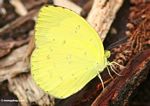
Yellow butterfly in Borneo
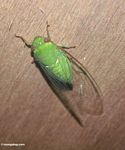
Bright green cicada
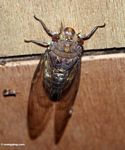
Brown cicada
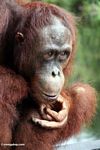
Rehabilitated orangutan lost in thought
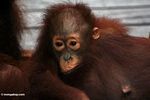
Baby orangutan clinging to mother orangutan
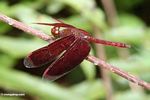
Red Grasshawk (Neurothemis fluctuans)
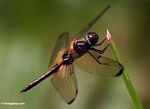
Brachydiplax dragonfly on blade of grass
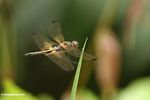
Brachydiplax dragonfly species
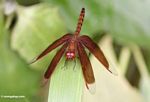
Grasshawk dragonfly (Neurothemis fluctuans)
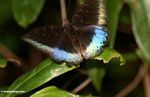
Blue and black butterfly in rainforest of Borneo
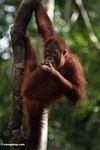
Young orangutan feeding while hanging from tree
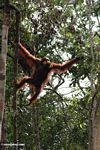
Orangutan climbing while holding a bunch of bananas in its mouth
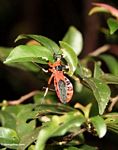
Red weevil-like insect with yellow and black legs
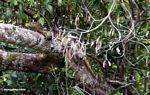
Water monitor lizard (Varanus salvator) on a branch above the Seikonyer River
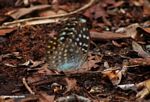
Yellow-, green-, and orange-spotted butterfly with blue underparts
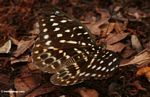
Yellow-, green-, and orange-spotted butterfly in leaf litter
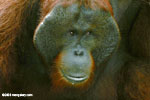
Adult male Borneo Orang-utan (Pongo pygmaeus) at Pondok Tanggui
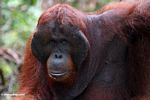
Ex-captive adult male Borneo Orangutan (Pongo pygmaeus)
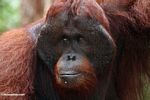
Adult male Orangutan at Pondok Tanggui
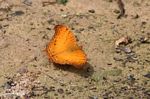
Orange butterfly on forest floor in Borneo
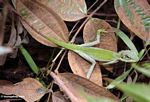
Green Crested Lizard (Bronchocela cristatella)
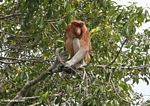
Adult male Proboscis monkey
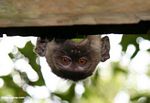
Long-tailed macaque (Macaca fascicularis) peeking over a roof so only its head is visible
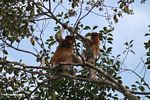
Adult male and baby proboscis monkeys in a canopy tree along the Seikonyer River
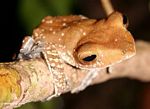
Tree frog in the tropical forest of Borneo

Blood-sucking leech on deck of 'klotok' (the traditional long boat of this part of Borneo)
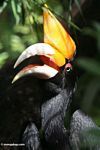
Rhinoceros Hornbill
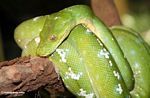
Green Tree Python
|
|
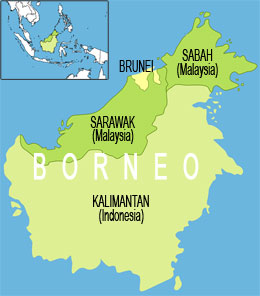
WILDLIFE OF BORNEO
Borneo's forests are highly biodiverse. According to WWF, the island is estimated have at least 222 species of mammals (44 of which are endemic), 420 resident birds (37 endemic), 100 amphibians, 394 fish (19 endemic), and 15,000 plants (6,000 endemic) -- more than 400 of which have been discovered in surveys since 1994.
Here is a brief look at some of Borneo's better known species of animals.
Birds
Borneo is perhaps best known for its hornbills -- eight species are found on the island. Large and noisy but also colorful and charismatic, hornbills have remarkable nesting behavior where the female is sealed on a tree hollow during the nesting period. At this time she is completely dependent on the male for food -- if he is captured or killed, the female and her offspring will die.
Mammals
As in most tropical rainforests, the vast majority of mammals on Borneo consist of bats and rodents, which play important ecological roles -- including seed dispersal and insect population control -- in the forest ecosystem.
There are 13 species of primates on the island, the best-known of which are the orangutan (Pongo pygmaeus), proboscis monkey (Nasalis larvatus), gibbon (Hylobates muelleri), and long-tailed macaque (Macaca fascicularis). Borneo is also home to the banteng (Bos javanicus), a species of wild ox; the highly endangered Sumatran rhinoceros (Dicerorhinus sumatrensis); the Asian elephant (Elephas maximus), which is smaller in stature than mainland elephants; the Sambar deer (Cervus unicolor), the clouded leopard (Neofelis nebulosa) and the sun bear (Helarctos malayanus).
Orangutan
The Orangutan is a great ape with long arms and reddish brown fur. Orangutans are presently found only in rainforests on Borneo and Sumatra, though they were once widely distributed in southeast Asia (as far as southern China). Today orangutans are highly endangered in the wild due to habitat loss (the destruction of rainforests for logging and agriculture) and the illegal trapping of baby orangutans for the pet trade. WWF estimates there were around 55,000 Bornean orangutans in 2004, but the number has since dropped largely as a result of widespread forest fires and increased clearing for oil palm plantations. In August 2006, the Wildlife Conservation Society-Indonesia Program said that Indonesia's population of orangutans stands at 20,000, down from 35,000 in 1996. Due to its slow rate of reproduction, environmental groups have warned that red ape could go extinct in the wild without urgent conservation measures. Genetic analysis has recently concluded that there are three subspecies of orangutan in Borneo: Pongo pygmaeus morio, the Northeastern Borneo orang-utan, Pongo pygmaeus wurmbii, the Central Borneo orang-utan and Pongo pygmaeus pygmaeus, the Northwest Borneo orang-utan. For more on the orangutan, take a look at orangutan articles and orangutan pictures
Proboscis monkey
The proboscis monkey lives only in the swampy lowland rainforests of coastal areas of Borneo and the Mentawai Islands. These large monkeys are best known for the male's large protruding nose. Proboscis monkeys are social animals, living in groups of 10 to 32 individuals led by a single dominant male. The local name for the proboscis monkeys is 'orang belanda', meaning 'Dutchman'. Indonesians say the with their big noses and red faces, they resemble the Dutch who used to have colonial control over Indonesia. The proboscis monkey is highly endangered -- less than 7000 are thought to exist in the wild
Müller's Bornean Gibbon
Müller's Bornean Gibbon (Hylobates muelleri) is endemic to the island of Borneo, inhabiting the northern and eastern part of the island. In the southwest of the island it is replaced by the Agile Gibbon. Gibbon are a type of ape that live in monogamous pairs. A couple's territory is usually defended by song. Like all gibbon, Müller's Bornean Gibbon is characterized by the long arms which are used to brachiate through the rainforest canopy. Müller's Bornean Gibbon eats fruit. There are three subspecies: Müller's Gray Gibbon (Hylobates muelleri muelleri), Abbott's Gray Gibbon (Hylobates muelleri abbotti), and the Northern Gray Gibbon (Hylobates muelleri funereus).
Sun bear
The Sun Bear is the world's smallest bear at approximately 4 ft (1.2 m) in length. It lives primarily in the tropical rainforests of southeast Asia. Primarily nocturnal, the sun bear is omnivorous feeding on a variety of plants and animals. Borneo has an endemic subspecies, Helarctos malayanus. Sun bears are today threatened by habitat loss and poaching, both for meat and medicinal purposes -- many Chinese believe sun bear parts have special healing powers. Sun bear are listed by the IUCN as endangered and protected by CITES.
Clouded leopard
The clouded leopard is a medium-sized cat found throughout southeast Asia. Recently (2002) added to the IUCN Red List, the clouded leopard is considered "vulnerable" due to habitat destruction and poaching for its coat. The clouded leopard is also sometimes available as a delicacy on menus in southeast Asia. Borneo has an endemic subspecies known as Neofelis nebulosa diardi.
Borneo Elephant
The Bornean Pygmy Elephant (Elephas maximus borneensis) is an elusive elephant limited to only a small part of northeastern Borneo. WWF says that there are five main concentrations of the elephant which is thought to have a total population of 1,000 - 1,500. The Bornean Pygmy Elephant is an endemic subspecies of the Asian elephant.
Borneo Rhinoceros
The Borneo Rhinoceros (Dicerorhinus sumatrensis harrissoni), an endemic subspecies of the Sumatran rhino, is the world's smallest rhino. It is also one of the most endangered with a population of less than 100 individuals. Poaching for its horn -- believed by the Chinese to have medicinal qualities even more potent than African rhino horn -- is the greatest threat to the species.
Banteng
The Banteng is a type of wild cattle found widely in southeast Asia. Banteng grow to about 1.6 meters at the shoulder and 2.3 m in head-body length. Banteng bulls can weigh up to a metric ton (2200 lbs). Banteng have been domesticated in some parts of southeast Asia. Today there are probably less than 10,000 pure strain Banteng left in the wild.
REFERENCES 
WWF Germany, Borneo: Treasure Island at Risk, June 2005 [pdf, 773 KB]
Lisa Curran, personal communication
mongabay.com
|


