New report calls for increased spending on hurricane research
|
|
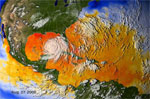
(09/29/2006) The National Science Board, a policymaking body of the National Science Foundation (NSF), has issued a new report calling for increased funding for hurricane research. A draft for public comment posted on the NSF web site urges more hurricane research to better anticipate storms and protect people and property from hurricanes while suggesting further investigation into the possible link between storm intensity and a warming climate. Recent research has suggested that warmer oceans could drive ever stronger and more frequent hurricanes.
[
Politics | Hurricanes]
Tiger fur trade thrives in China
(09/28/2006) The illegal tiger and leopard fur trade continues to thrive in China according to recent investigations by the Environmental Investigation Agency (EIA) and the Wildlife Protection Society of India (WPSI). The organizations say that the trade is "operating without any hindrance from the Chinese government" and endangers surviving wild tiger populations in India.
[
Biodiversity | China]
Newly discovered species in the Amazon, as new protected area announced
|
|
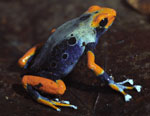
(09/27/2006) Brazil has announced the creation of a Amap· State Forest, a 5.7 million acre Amazon protected area larger than the state of New Jersey. According to Conservation International (CI), a conservation group involved with the creation of the state forest, "the designation protects a crucial section of the Amap· Biodiversity Corridor of northern Brazil, which includes some of the most pristine remaining Amazon forest" and is home to some twenty three newly discovered species.
[
Amazon | Biodiversity]
Protecting sea turtles in Costa Rica
|
|
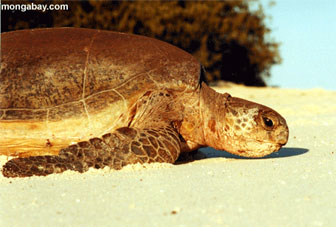
(09/27/2006) No"l Dunn's account of monitoring sea turtle nesting sites on the beaches of Costa Rica: "If my backyard is the jungle my front lawn is the beach. It is on this buffer, this black sand gateway between the bottomless ocean and the dense bush that a relentless game of Hide and Seek is played. This high-stakes match involves buried treasure, wealth and almost certain death. The chance of a leatherback sea turtle's survival is a tragedy revealed in the salty-tears released by each mother as she lays her eggs. One sea turtle out of 1000 hatchlings will live. If it is a female she will return to this beach in 20 years to repeat the cycle. If it is a male, he will never stand on the beach again. The rest will die. It is for that one turtle out of 1000 that I am here. I along with countless others around the world walk miles on beaches at night because the birds, the ocelots and pumas, the jaguars, the octopus, the big fish, the sharks, the fish nets and the boat propellers are not their only threats. These predators at least allow the turtles to hatch. Human poachers don't allow that to happen."
[
Sea Turtles]
Methane emissions rising, could worsen global warming
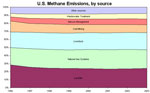
(09/27/2006) Concentrations of methane, a greenhouse gas more than twenty times more potent than carbon dioxide, are rising in Earth's atmosphere finds a new study published in Nature. After declining in the 1990s due to the industrial collapse of the Soviet Union, and the combination of more efficient use of natural gas and efforts to reduce landfill methane emissions in the West, emissions have risen since 1999 due possibly, in part, to the booming Chinese economy.
[
Climate Change]
Coral reefs survive tsunami but not cyanide bombs
(09/27/2006) The impact of a tsunami on a coral reef is minimal in comparison to human-caused damage according to a new study published in the journal Atoll Research Bulletin. The research, conducted less than 100 days after the massive Indian Ocean tsunami of December 26th, 2004, found limited damage to coral or reef fish communities across 49 reefs surveyed in northern Aceh, Indonesia. However, the researchers say that human use of explosives and poison for fishing has taken a heavy toll on reefs in the region.
[
Coral Reefs | Oceans]
California Oil Tax Pits Venture Capitalists Versus Big Oil
(09/27/2006) Oil firms are locked in a fierce battle with venture capitalists and environmentalists over Proposition 87, California's proposed oil tax, according to an article in today's issue of The Wall Street Journal. California votes on the initiative November 7. Backing the proposition, which calls for a tax on oil output to fund conservation and alternative-energy initiatives, are some of the Silicon Valleys's most prominent figures including Vinod Khosla, a venture capitalist (VC); Larry Page, a co-founder of Google; Wendy Schmidt, wife of Google Chief Executive Eric Schmidt; and John Doerr, a one of the best known VCs. California's oil producers and refiners strongly oppose the measure which would result in up to $4 billion in higher production costs over the next decade.
[
Politics | Energy]
Bush administration blocks report linking hurricanes to global warming
|
|
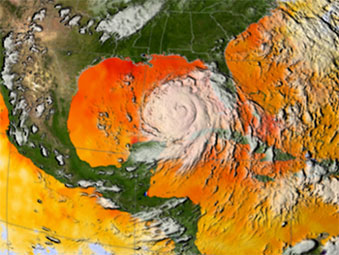
(09/26/2006) The Bush administration blocked release of a report suggesting that global warming is contributing to the frequency and strength of hurricanes, the journal Nature reported Tuesday. According to Nature, a panel of National Oceanic and Atmospheric Administration scientists drafted a February report that linked recent hurricane activity to human-induced climate change. When the study was scheduled to be released in May, officials at the Commerce Department rejected the report on technical grounds and prohibited its publication.
[
Politics | Climate Change]
Arctic ocean warms as global oceans cool
(09/26/2006) Scientists at the University of Alaska Fairbanks International Arctic Research Center say that warm water from the North Atlantic Ocean continues to surge into the Arctic Ocean potentially increasing ice melt in the region.
[
Climate Change | Greenland-Arctic]
Negative messaging not effective for green movement, finds study
(09/26/2006) New research suggests that negative messaging is not effective in convincing people to adopt green initiatives. The study, published by the Economic and Social Research Council, shows that "positive, informative strategies" are far more more effective in encouraging behavior change than "negatives strategies which employ messages of fear, guilt or regret."
[
Green Business]
Not extinct? Ivory-billed Woodpecker may live in Florida

|
|
(09/26/2006) Researchers found evidence of the Ivory-billed Woodpecker, a bird once believed to be extinct, in a remote river basin in the panhandle of Florida. The discovery, announced in Avian Conservation and Ecology, was made in May 2005 by a research team led by Auburn University professor Geoff Hill. The bird was sighted on the Choctawhatchee River and though the team captured no photographs of the species.
[
Extinction]
Global warming: Earth's temperature near highest level in a million years
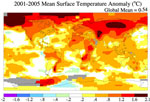
(09/25/2006) Earth may nearing its warmest level in the last million years according to a paper published by NASA scientists in the Proceedings of the National Academy of Sciences. James Hansen of NASA's Goddard Institute for Space Studies in New York City and colleagues report that "Earth is now reaching and passing through the warmest levels in the current interglacial period" and that global temperature may be within one degree Celsius (1.8°F) of the maximum temperature of the past million years. "That means that further global warming of 1 degree Celsius defines a critical level. If warming is kept less than that, effects of global warming may be relatively manageable," said Hansen. "During the warmest interglacial periods the Earth was reasonably similar to today. But if further global warming reaches 2 or 3 degrees Celsius, we will likely see changes that make Earth a different planet than the one we know. The last time it was that warm was in the middle Pliocene, about three million years ago, when sea level was estimated to have been about 25 meters (80 feet) higher than today."
[
Climate Change]
Conservationists killed in Nepal helicopter crash
(09/25/2006) 24 people were killed in a helicopter crash in Nepal on Saturday September 23rd. Seven of the victims were staff members of WWF, a leading conservation group. The helicopter was carrying them from a conservation site at Ghunsa, in the remote eastern mountains of Nepal, according to WWF.
[
Conservation]
Boreal forests worth $250 billion per year worldwide
(09/25/2006) Boreal forests provide services worth $250 billion per year globally according to estimates by Canadian researchers. Mark Anielski, an Edmonton economist, says that environmental services from the boreal -- including carbon capture and storage, water filtration and waste treatment, biodiversity maintenance, and pest control -- are worth about $160 per hectare, or $93 billion per year in Canada alone.
[
Forests]
Dinosaurs survived rapid climate change
(09/23/2006) New research suggests the existence of periods of dramatic climate change during the Mesozoic Era, a time when dinosaurs ruled the Earth.
[
Climate Change]
Add invasive species status to list of biofuel concerns
(09/22/2006) High energy prices over the past couple years have fueled interest in biofuels, which proponents say are less damaging to the environment and provide energy security not afforded by foreign oil and gas imports. Nevertheless, accompanying their rise in visibility, have been concerns over their environmental impact of converting natural vegetation for their production. Now scientists warn that some biofuel crops pose a risk as invasive species.
[
Energy]
California sues Bush administration forest law repeal
(09/21/2006) Yesterday California sued the Bush Administration over its repeal of the Clinton Administration's "Roadless Rule". According to a release from state Attorney General Bill Lockyer, "The Northern Federal District of California ruled the U.S. Forest Service violated federal environmental laws by stripping national forest roadless areas of protection from road-building and logging without performing any environmental analysis of the consequences. The court ordered the immediate reinstatement of protections for nearly 50 million acres of remaining undeveloped forests."
[
Politics | Forests]
Greenland's ice continues to melt
(09/21/2006) Data gathered by a pair of NASA satellites orbiting Earth show Greenland continued to lose ice mass at a significant rate through April 2006, and that the rate of loss is accelerating, according to a new University of Colorado at Boulder study.
[
Climate Change | Greenland-Arctic]
California sues automakers over global warming
(09/21/2006) California sued six of the world's largest automakers over greenhouse gas emissions charging that pollution their vehicles have caused billions of dollars in health damages. Auto industry representatives said the action was political and just in time for November.
[
Pollution | Climate Change | Politics]
Tree rings could settle global warming hurricane debate
|
|
(09/20/2006)
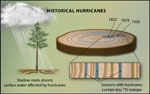
Scientists have shown that ancient tree rings could help settle the debate as to whether hurricanes are strengthening in intensity due to global warming. By measuring different isotopes of oxygen present in the rings, Professors Claudia Mora and Henri Grissino-Mayer of the University of Tennessee have identified periods when hurricanes hit areas of the Southeastern United States up to 500 years ago. The research could help create a record of hurricanes that would help researchers understand hurricane frequency and intensity. Currently reliable history for hurricanes only dates back a generation or so. Prior to that, the official hurricane records kept by the National Oceanic and Atmospheric Administration's Atlantic basin hurricane database (HURDAT) are controversial at best since storm data from more than 20 years ago is not nearly as accurate as current hurricane data due to improvements in tracking technology. The lack of a credible baseline makes it nearly impossible to accurately compare storm frequency and strength over the period..
[
Hurricanes | Climate Change]
Rare, 90-million-year-old tree for sale
(09/20/2006) The National Geographic Society announced it will sell the Wollemi Pine, one of the world's oldest and rarest trees, to consumers in the United States this holiday season. Fewer than 100 tree exist in the wild. National Geographic sees the sales as an opportunity to conserve and propagate the species, which was believed to be extinct until a small grove of trees was discovered in Australia's Blue Mountains in 1994.
[
Extinction]
Amazon rainforest has its first wireless city under poverty alleviation initiative by Intel
(09/20/2006) Intel unveiled what it is calling the "World's Most Remote Digital City" in the heart of the Amazon rainforest. The wireless, high-speed Internet network installation in Parintins, a town on an island in the Amazon River, is part of the tech firm's initiative to treat the world's poor as a market. Some economists have argued that addressing the world's poor in such a manner could bring benefits that they have not seen through historical aid efforts.
[
Poverty Alleviation | Technology]
Dinosaurs and cocktails together in San Francisco

|
|
(09/19/2006)
If you live in the San Francisco Bay Area and like giant scaly beasts then you might want to head down to the California Academy of Sciences Thursday evening to explore its latest exhibit, DINOSAURS: Ancient Fossils, New Discoveries. From 5-9 PM on September 21st, visitors can learn about the latest dinosaur discoveries while enjoying Brazilian jazz and cocktails. Of course the aquarium's famous finned creatures and smaller scaly beasts will also be on display.
[
Extinction]
$230B for moon return but only $30M for deep ocean research?
|
|
(09/19/2006)
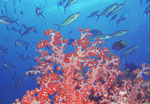
In an editorial sent to mongabay.com, Russell Mittermeier, president of Conservation International (CI), expresses frustration that we don't put more funds toward studying Earth instead of financing expensive return trips to the desolate and lifeless moon. "I'm frustrated that we don't spend more effort and money investigating our own planet," writes Mittermeier, a well-known biologist. "Amazing new species are still being discovered here on Earth that help answer the same questions we seek to resolve in space, and vast new frontiers remain to be conquered beneath the oceans."
[
Biodiversity | Politics]
Arctic ice hole larger than Britain forms, shocks scientists
|
|
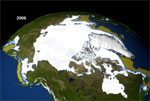
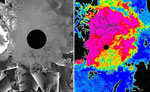
(09/19/2006) European Space Agency satellite images acquired from 23 to 25 August 2006 have shown for the first time dramatic openings larger than the size of the British Isles in the Arctic's perennial sea ice pack north of Svalbard, and extending into the Russian Arctic all the way to the North Pole. The agency says the findings are shocking to scientists. "If this anomaly trend continues, the North-East Passage or ëNorthern Sea Route' between Europe and Asia will be open over longer intervals of time, and it is conceivable we might see attempts at sailing around the world directly across the summer Arctic Ocean within the next 10-20 years," said Mark Drinkwater, a scientist with ESA.
[
Greenland-Arctic]
Extent of Mercury Pollution More Widespread, Report Shows
(09/19/2006) Mercury pollution is making its way into nearly every habitat in the U.S., exposing countless species of wildlife to potentially harmful levels of mercury, a new report from the National Wildlife Federation shows.
[
Pollution]
Expansion of agriculture in the Amazon may impact climate
|
|
(09/19/2006)
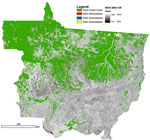
The study, published online in the September 14, 2006 edition of the Proceedings of the National Academy of Sciences, used data from field observations and NASA's Moderate Resolution Imaging Spectroradiometer (MODIS) to examine cropland expansion in Mato Grosso, the Brazilian state with the highest deforestation and soybean production rates in recent years. The researchers found that in 2003 more than 20 percent of the state's forests were converted to cropland, suggesting that the recent expansion of mechanized cropland in the region is contributing significantly to deforestation.
[
Amazon | Deforestation]
China moves as environmental problems mount
|
|
(09/19/2006)
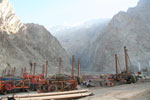
China, the world's most populous country and fastest growing economy, faces a host of environmental problems. Energy and water shortages, water and air pollution, cropland and biodiversity losses, and escalating emissions of greenhouses gases are all concerns as the country moves towards world superpower status. While these issues could threaten to destabilize the country and derail economic growth, it appears that it is taking steps to address some of these challenges.
[
China]
Not so happy 5th birthday for mongabay
(09/18/2006)
Mongabay.com and related sites suffered a major server failure last week. Backup files were corrupted and the backup system conveniently failed as well. Nevertheless, a full recovery looks likely for mongabay and wildmadagascar by the end of this week. Thank you for your patience--it wasn't the best 5-year anniversary performance for the site. On a more positive note, earlier this month the site got a mention in The Wall Street Journal Online ("Not Letting Success Get to Your Head" on Sept. 8).
War-torn Congo Announces Two New Parks
(09/18/2006)
The Republic of Congo announced plans to create two new protected areas that together could be larger than Yellowstone National Park. The Wildlife Conservation Society, which will help administer the reserves, says that the parks will protect an area that is home to some of the highest gorilla populations in the world.
[
Congo | Conservation]
Climate Change Threatens Lemurs
(09/18/2006)
Dr. Patricia Wright, a well-known lemur expert from Stony Brook University, says that climate change could cause the extinction for endangered lemur species due to changes in their rainforest habitat. Wright will present her findings at a public meeting of the Explorer's Club in New York on September 18.
[
Madagascar | Primates | Climate Change]
Arctic ice melting rapidly, polar bears suffering - new research
(09/18/2006)
New research shows that Arctic sea ice is rapidly disappearing. Scientists say that the human-induced buildup of greenhouse gases in the atmosphere is a leading culprit behind the decline. According to a study to be published in the journal Geophysical Research Letters this month, the maximum amount of sea ice in the Arctic winter has fallen by six percent over each of the last two winters, while summer sea ice continues to retreat at an average of ten percent per decade.
[
Climate Change | Greenland-Arctic]
New species of 'walking' shark discovered
(09/18/2006)
Conservation International announced the discovery of dozens of marine species -- including a "walking" shark and colorful fish -- off the coast of New Guinea. The findings are the result of three recent rapid assessment (RAP) surveys which sought to document biodiversity in this ecosystem threatened by dynamite and cyanide fishing and pollution from deforestation and mining.
[
Oceans | Biodiversity]