March 31, 2006
Winter air temperatures over Antarctica have risen by more than 2C in the last 30 years, according to a study by scientists from the British Antarctic Survey. The increase of Antarctic temperature is three times larger than that observed globally over the same time period.
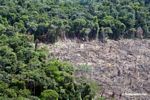
Forest fragmentation may cause biodiversity loss lasting millions of years according to a study published in the March 31, 2006 issue of the journal Science.
March 30, 2006
Most mass extinctions were caused by gradual climate change rather than catastrophic asteroid impacts says Peter Ward, a paleontologist at the University of Washington in Seattle, in an upcoming article in New Scientist magazine.
Environmental group Greenpeace is going after pirate fishermen off the coast of West Africa, according to an article posted on Time.com. Illegal fishing is depleting the region's fishing stocks and fueling the bushmeat trade.
March 29, 2006
I spent most of February in Indonesia, on the islands of Borneo, Sulawesi, Java, and Bali. I have posted more than 2000 pictures from the trip: Indonesia photos
Indonesia announced it would end plans to establish a 1.8 million hectare oil plantation in the rainforest of Borneo. The proposed plan, which was backed by Chinese investments, would have destroyed one of the most biodiverse ecosystems on Earth. Some observers said that the project was a cover for massive logging scheme.
March 28, 2006
At the United Nations-sponsored environmental conference meeting in Curitiba, Brazil announced plans to protect an additional 210,000 square kilometers (84,000 square miles) of the Amazon rain forest in the next three years.
March 24, 2006
New research says if current warming trends continue, the Greenland and Antarctic ice sheets are on track to melt sooner than previously thought, leading to a global sea level rise of at least 20 feet.
March 23, 2006
Scientists warned that 40 percent of the Amazon rainforest could be lost by 2050 due to agricultural expansion unless strict measures are taken to protect the world's largest tropical forest. There is also concern that climate change could cause the as much as half the Amazon to revert to savanna.
Greenpeace launched a set of satellite maps showing the world's remaining extent of "intact forests"--the planet's most biodiverse ecosystems. Greenpeace says that protecting these last intact forests should be a top priority for world governments at the biodiversity meeting in Brazil this week and hopes these maps can serve as a starting point for monitoring and conservation efforts.
March 22, 2006
According to the United Nations, the continuing degradation of the world's dryland ecosystems is threatening biodiversity and worsening poverty around the globe. In an effort to bring attention to the dire condition of these important lands, which cover almost half the planet's land surface, the world organization has proclaimed 2006 the International Year of Deserts and Desertification.
March 21, 2006
New research out of the University of Arizona has found that the Amazon rainforest grows fastest during the dry season. The finding counters the convention in other ecosystems where peak plant growth generally occurs during the rainy season.
March 20, 2006
Taman Negara is Malaysia's largest and best-known national park. Spanning 4343 square kilometers, the protected forest area is home to some of southeast Asia's rarest creatures including tigers, the Malaysian tapir, forest elephants, and the Sumatran rhino. Scientists believe that these rainforests may be the oldest on Earth. Untouched by glaciers during recent ice ages, Taman Negara's forests have remained largely the same for some 130 million years. This stability produces some of the highest levels of biodiversity on Earth: more than 350 species of birds, 14000 species of plants, and 210 species of mammals can be found in Taman Negara.
More than 3000 delegates are meeting in Brazil to discuss the future of global biodiversity.
I will be traveling this week — updates may be irregular.
March 18, 2006
Scientists have confirmed that climate warming is changing how much water remains locked in the Antarctic and Greenland ice sheets, according to an article published in the Journal of Glaciology.
World Wildlife Fund today the results of a field survey from the island of Borneo which found that poaching has significantly reduced Borneo's population of Sumatran rhinos, but a small group continues to survive in the "Heart of Borneo," a region covered with vast tracts of rain forest.
March 17, 2006
The Malaysian state of Sabah on the island of Borneo announced it will phase out logging in large parts of its remaining rainforests. Sabah, once home to some of the world's most biodiverse forests, was largely logged out during the 1980s and 1990s but some parts of the state still support wild populations of endangered orangutans. In recent years, the Malaysian government has set aside protected areas and sponsored reforestation projects in the state
The link between warmer ocean temperatures and increasing intensity of hurricanes has been confirmed by scientists at the Georgia Institute of Technology. Last year, two studies published in the journals Nature and Science found a strong correlation between rising tropical sea surface temperatures and an increase in the strength of hurricanes.
Indian Ocean coral reefs that escaped serious damage are coming under increasing threat from reconstruction efforts in the region according to a new report from the international environmental groups, World Conservation Union and the Global Coral Reef Monitoring Network.
March 16, 2006
A new survey released by the nonpartisan Civil Society Institute found that 76 percent of Americans think the federal government is not doing enough to address global warming and develop alternative energy sources in order to reduce our dependence on foreign oil.
Microsoft's Bill Gates mocked a $100 laptop computer for developing countries being built by the Massachusetts Institute of Technology (MIT). MIT, with support from Google, AMD, Brightstar, News Corporation, and Red Hat, is developing the low-cost laptop to boost education efforts in the some of the world's poorest regions. With his arch rivals supporting the project, Gates criticized the machine at the Microsoft Government Leaders Forum in suburban Washington.
March 15, 2006
Air pollution has played a significant role in Arctic climate change says new research from NASA. Scientists at NASA's Goddard Institute for Space Studies found that ozone -- also known as "smog" -- was responsible for one-third to half of the observed warming trend in the Arctic during winter and spring.
Decades of federally-subsidized predator control has failed to prevent a long-term decline in the sheep industry, according to a study by the Wildlife Conservation Society. The study, which appears in the latest issue of the journal Conservation Biology, says that market forces ñ not predators ñ are responsible for the drop-off in sheep numbers.
March 14, 2006
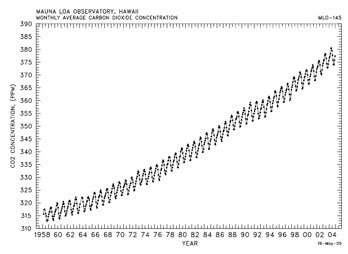
Atmospheric carbon dioxide levels jumped 2.6 parts per million (ppm) in 2005, one of the largest increases on record according to data from the National Oceanic and Atmospheric Administration (NOAA). Carbon dioxide levels now stand at 381 ppm, about 36 percent above pre-industrial levels. Meanwhile a controversial new theory attributes climate change not to atmospheric carbon dioxide levels but to water vapor released by the Tunguska Event, a massive explosion over Siberia on the June 30th, 1908.
A new study out of Cornell University suggests that environmentalism is born in children who are exposed to nature before the age of 11. Nancy Wells and Kristi Lekies found that "wild" nature activities in childhood are correlated to adult interest in the environment.
Cleaner, more efficient use of coal could play a key role in addressing climate change. Coal presently supplies about two-thirds of China's energy and one-third of the energy demand in the United States but, due to its abundance, is forecast to become an increasingly important relative to petroleum around mid-century. A new chemical process for removing impurities from coal could lead to significant reductions in carbon dioxide emissions from coal-fired power stations say researchers at the University of Nottingham.
When predators learn to avoid a highly toxic frog, they generalize, and this allows a harmless frog to mimic and be more abundant than a frog whose poison packs less punch, biologists at The University of Texas at Austin studying poison dart frogs in the Amazon have discovered.
March 13, 2006
New research published in Science suggests that colonization of Easter Island took place around A.D. 1200, later than originally believed. The later settlement date supports the premise that human impact on the environment—specifically deforestation and the introduction of an alien species— played a key role in the downfall of Easter Island society.
March 10, 2006
The newly discovered species of rodent found in a marketplace in Central Laos turns out to not be so new after all. The Laotian rock rat, as the long-whiskered and stubby-legged rodent is now known, is a species believed to have been extinct for 11 million years. It is a member of a family that, until now, was only known from the fossil record.
Preventing carbon dioxide levels from rising to potentially dangerous levels could cost less far less than originally projected—less 1 percent of gross world product as of 2050—but a major shift in the way energy is found, transformed, transported and used will be necessary to prevent a severe energy crisis within the next century, say researchers from the The Earth Institute.
Physical changes—including rising air and seawater temperatures and decreasing seasonal ice cover—appear to be causing biological changes in the northern Bering Sea ecosystem that could have long-range and irreversible effects on the animals that live there and on the people who depend on them for their livelihoods says a new paper published March 10 in the journal Science.
March 9, 2006
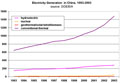
Wind could become China's second-largest source of electricity according to a Chinese energy expert. Wang Weicheng, an energy professor at Tsinghua University in Beijing, told reporters that China has the potential to install up to 100 gigawatts of wind power. Wang's comments come as China has been aggressively expanding its interests in renewable energy sources including wind, solar, biofuels, tidal, and small hydroelectric dams.
The Camisea gas pipeline in the Peruvian Amazon has leaked for the fifth time in 18 months according to Reuters. Two people were injured and a small fire was ignited by the spill of 750 cubic meters of gas.
Illegal logging is destroying large areas of rainforest in Papua New Guinea according to a report released last week by Forest Trends, a leading international forestry organization.
March 8, 2006
Divers found a new species of crustacean living deep in hydrothermal vents of the South Pacific. The creature resembles a lobster covered with "silky, blond" fur say researchers who made the discovery.
Maize, better known as corn in some parts of the world, was cultivated by people living in the Peruvian Andes of South America about 1,000 years earlier than previously believed reported a team of researchers last week.
March 7, 2006
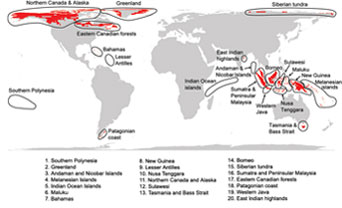
Scientists have identified 20 potential extinction hotspots where hunting and human-caused habitat destruction are set to suffer significant declines in animal populations in coming years. In developing their map of future extinction hotspots, the researchers analyzed current and predicted IUCN Red List data on the extinction risk to almost 4,000 species of land mammals. Their roster includes areas not typically found on lists of the world's most imperiled habitats, including Greenland, the Patagonian coast of South America, and Siberian tundra.
A new study confirms the notion that organic farming is an environmentally friendly alternative to conventional agriculture.
March 6, 2006
Last week Brazilian president Luiz Inacio Lula da Silva announced a plan to allow sustainable logging across 3 percent of the Amazon rain forest. The law is aimed at undermining destructive illegal logging activities while generating revenue for forest management and protection, and income for rural Brazilians in the region who often must rely on subsistence agriculture or employment on ranches and plantations under sometimes slave-like conditions.
The Antarctic ice sheet continues to shrink according to a NASA study released last week. Using data from the Gravity Recovery and Climate Experiment (GRACE) scientists concluded that Antarctica's ice sheet decreased by about 152 cubic kilometers annually from April 2002 to August 2005, or about 36 times the annual amount of water used by the city of Los Angeles.
March 5, 2006
I apologize for sections of the site being down while I was traveling in the forests of Indonesia and Malaysia. The performance of the site should improve upon my return to an environment with stable internet connectivity